Key takeaways
- In our view, the unit you charge for largely decides who keeps the account, the usage data and the volume risk over the contract term, so choose it ahead of any rate.
- In our view, the first question in a usage-based offer is not the price per scan but who carries the risk when volume drops.
- In our experience, many offers sold as usage-based are fixed fees with service bundled in, so check that pay per use is genuinely live before quoting it.
A medical device pricing strategy for a service contract starts with a familiar request: a new scanner, without a capital request. You can answer with a price per scan, per patient, a monthly fee, or a fixed fee with part of it at risk. Each answer creates a different business. This article helps device makers, and the integrators who install, finance and maintain their equipment, choose the metric to sell first and who carries the volume risk behind it.
Our whitepaper As-a-Service for Medical Devices sets the order: define one customer value metric, such as a price per scan, per patient or a monthly fee, before anything else, then build the pricing, bundling and limits that protect margin around it. The paper rests on public MedTech cases and on more than 500 industrial As-a-Service cases studied by P2S, so the lessons drawn from that wider base are cross-sector.
We cover hospitals, imaging centres and clinical labs in Europe and the US. Home-care devices are out of scope: a prescriber, a payer and a home-care supplier stand between maker and patient, a different chain of buyers.
Why the metric matters more than the rate
The metric decides what you keep. In our view, a capital sale usually hands over the usage data and the next buying decision on delivery. A price per scan or per patient keeps the maker in the account for the term.
Large players are moving. Intuitive Surgical says in its FY2025 Form 10-K that it is "increasingly offering usage-based arrangements".
For a maker, the risk is a quarrel with its own channel. Distributors and service partners that earn on the capital sale or the maintenance contract will ask where they sit once the hospital pays per scan. Settle that seat before the first quote: reseller, named service partner or financing partner.
For an integrator, the risk is becoming the subcontractor of whoever holds the usage contract. In our view, the party that invoices per scan usually holds the meter reading and the renewal. An integrator named in that contract negotiates from a stronger position than one paid as a cost line beneath it.
Buyers can compare it. In the EU, public tenders can award contracts on life-cycle cost under Directive 2014/24/EU; in the US, value analysis committees review new products and group purchasing organisations negotiate many supply contracts. A metric the buyer can set against ownership cost scores more easily.
What a value metric is, and what sits outside it
Definition. A value metric is the unit a customer pays for under a service contract: a scan, a procedure, a patient day, a bed in use or a month of access. It decides how the invoice moves when usage changes, and so who carries the volume risk.
The metric is one of four separate choices, next to the promise, the performance commitment and the remedy. Our guide to Medical-Device-as-a-Service covers the promise.
The CFO's first question is about the costs the metric leaves out. Agree in writing who pays for consumables, power and the staff who run the device, and how the unit rate moves over the term: a fixed annual step, an index such as consumer prices, or a pass-through of a named cost. These are points to agree with the hospital, not defaults.
Medical device pricing strategy: five metrics side by side
| Per scan or procedure | Per patient or census | Monthly fee | Fixed fee plus KPI share | Result-linked price | |
|---|---|---|---|---|---|
| How the invoice moves | With each scan or procedure | With patients monitored or beds in use, reset monthly or yearly | It does not move within the term | Mostly fixed; a share moves with KPIs such as uptime | With an agreed operational, clinical or economic result |
| Published as | Pay-per-procedure financing (Philips); usage-based operating leases (Intuitive Surgical) | Census-based and per-patient subscriptions (Nihon Kohden, 2019); pay per patient per day, by acuity (Philips EMaaS, 2021 summary) | Flat monthly subscription (Nihon Kohden, 2019) | Performance-sharing model: monthly flat fee plus KPI-linked payments (Siemens Healthineers) | Risk-share agreement with a rebate (Medtronic TYRX, 2018) |
| Who carries the volume risk | The provider, unless a floor, a band or a third party covers it | Shared: the provider until the next reset | The customer | Mostly the customer; the provider carries the KPI risk | The provider carries the result risk; volume risk depends on the design |
| Data needed | Usage counts both sides accept | Census or patient counts from the hospital's systems | Access and uptime | KPI data both sides trust | An agreed baseline, data owner and method |
| Billing load | High: the invoice changes every month | Medium | Low | Medium | High: reconciled against the result |
| Running costs and price moves (points to agree) | Consumables in or out of the rate; yearly step or index | Census source and reset date; index | Index or fixed step; fee change when products are added | Index on the fixed part; KPI exclusions | Baseline revision; who absorbs a tariff change |
The labels blur in practice: a managed fleet often bills part of its fee per use, and a monthly fee can include a volume band. What separates them is which invoice line moves when patient numbers fall. For models outside MedTech, see Hardware-as-a-Service pricing models.
The case: one monitoring fleet, three prices (Nihon Kohden, US hospitals)
Nihon Kohden launched patient monitoring subscriptions in the US in 2019, priced monthly, by census or per patient, with no upfront fees.
The customer problem. Announcing the offer, the president and CEO of Nihon Kohden America described hospitals under pressure to drive down costs, many of which put off replacing systems until they can no longer repair them.
The commitment. On 11 December 2019 the company announced subscriptions for its patient monitoring and neurology products, which it called an industry first (company-announced). Hospitals could choose a flat monthly payment, a census-based payment adjusted each year, or a per-patient fee adjusted each month to actual use. Infrastructure, training and installation sit inside the subscription. Products can be added or refreshed during the term by raising the payment or extending the term, and the hospital can buy the installed equipment at the end.
The design decisions. In our reading, the three options hand the volume risk over in steps. The flat fee leaves it with the hospital, the census fee shares it with a lag of up to a year, and the per-patient fee moves most of it to Nihon Kohden.
The result. We found no published uptake figures. The design lesson: a menu of metrics lets the hospital choose its share of the volume risk, and the maker price each share.
Who carries the risk when volume drops
The price per scan comes second. In our engagements across industries, most usage offers that fail had not settled this question before signing.
Volume sits largely outside the device maker's control: referrals, staffing, theatre scheduling, a competing service nearby and tariff changes each move it. A price per scan hands those swings to whoever is paid per scan, unless the contract moves them back.
Several published MedTech offers pair usage pricing with an upfront or fixed payment: the Elekta and MedAccess partnership lets countries pay an upfront fee before paying per patient, and Philips offers EMaaS 180, a mix of upfront costs and a subscription, next to its pay-per-use EMaaS 360. Public terms show four splits:
- Generally no floor, priced on expected use. Intuitive Surgical leases some systems with payments based on use. Its FY2025 Form 10-K warns that, because future use is hard to forecast, it may not set usage-based rates high enough to maintain its gross profit margins, and that some leases let customers cancel, return or upgrade early without a financial penalty.
- A floor and a ceiling. Philips Capital's pay-per-use financing for IT solutions links part of the repayments to patient volumes. Below agreed volumes the customer pays floor payments; above a ceiling, extra use costs nothing more.
- A long term with a financing partner. Philips, in partnership with DLL, financed an interventional radiology suite at Broomfield Hospital (Mid and South Essex NHS Foundation Trust) on a 13-year pay-per-procedure contract, with no upfront capital from the trust.
- A third party takes the shortfall. Under a partnership Elekta and MedAccess launched in April 2025 for Kenya and Tanzania, countries can pay an upfront fee, then pay each time a patient starts treatment. Where governments request this model, MedAccess guarantees a minimum number of patients per installed machine and covers any shortfall (public and public-private facilities).

Three design options limit the exposure in a first contract (our reasoning, not a market standard). A floor is a minimum monthly payment. A band is a fixed fee for an agreed volume range, with a per-scan rate above it. A minimum commitment for the first years can lapse once both sides hold real usage data. Choose by control: when the hospital decides referrals and staffing, it should carry part of a drop.
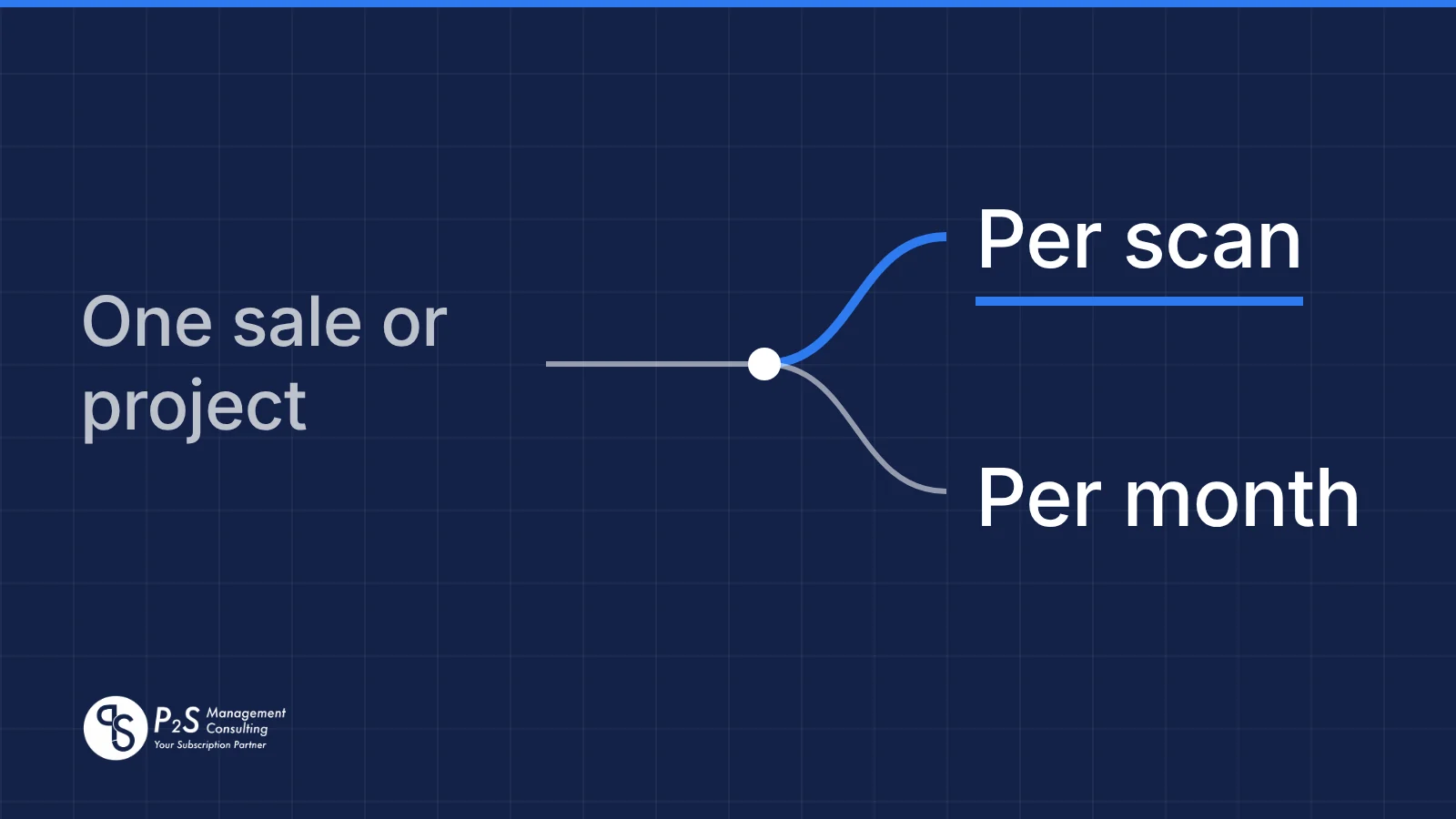
So should a medical device company sell per scan or per month? In our view, sell per scan where you can see the volume and influence it, and per month where the hospital controls it. A common margin risk in a usage price is a volume forecast set at best case rather than field conditions.
Three-part pricing for managed fleets and labs
P2S recommends a three-part price for managed fleets and labs: a fixed fee for equipment access, a fixed fee for maintenance, software and training, and an at-risk part made of usage charges and a performance share.
The structure fits multi-asset fleets and labs under one contract, not a single scanner on a per-scan rate. The fixed parts fund the asset and the service team whatever happens to patient numbers; the at-risk part puts the hospital's use and the provider's performance on the invoice. Siemens Healthineers describes a similar model, where available: a monthly flat fee plus payments linked to predefined KPIs. Choosing the KPI is covered in outcome-based contracting and SLAs.
Our position: set discount discipline and renewal terms before the first contract. A fixed part discounted to win the deal is hard to raise later, leaving the at-risk part to carry the margin.
Where to hold back on per-scan pricing
- Check the offer is what it says. In our experience, many offers sold as usage-based are fixed fees with service bundled in, so check that pay per use is genuinely live before quoting it. Outcome-linked payment is rarer still: a 2025 Czech stakeholder study in Frontiers in Public Health notes that risk-sharing is increasingly applied in pharmaceuticals, while its use for medical devices remains limited.
- Start on a band. In our view, it gives both sides a year of data before the floor and the rate are tested.
- Fix the billing first. Our position is that CRM, ERP and billing should invoice per scan or per patient without manual work by the first invoice; a multi-site fleet billed by hand does not scale. Our guide to subscription management software covers the systems.
- Bring in a balance sheet. A financing partner can remove the hospital's capital need, as Philips and DLL did at Broomfield.
The first usage contract needs data, billing and capital in place at the same time. P2S can help as adviser, or join a maker or an integrator as operating partner in a co-venture, where part of our fee can be tied to the recurring revenue the contract earns.
Frequently asked questions
Is pay per use common for medical devices?
In our view, less common than the labels suggest. Published usage terms exist at Intuitive Surgical, Philips and Elekta, and each places the volume risk somewhere: in the rate, a floor, an upfront payment or, in Elekta's case, a third-party guarantee where governments request it.
Should the price per scan fall as volume rises?
It can, but agree the ceiling together with the floor, as Philips Capital's IT financing does. A falling rate rewards the hospital for growth; a ceiling caps its budget. Model your margin at field volumes either way.
Pick the metric you can bill and defend
Take one device line and one metric. Name who controls the volume, write a floor or a band into the first contract, and confirm your billing can invoice it. Then the rate per scan becomes arithmetic rather than a negotiation.
Book a call with a partner to test which metric fits your first device line, and where the volume risk should sit before you quote. Book a call. For the value metric of each contract model, the pricing architecture for managed fleets and the six recurring margin risks in these contracts, download As-a-Service for Medical Devices.
Related reading
- Medical-Device-as-a-Service: which contract model can you deliver first?
- Value metrics and metering
- Hardware-as-a-Service pricing models: 5 options compared
- XaaS subscription packaging strategies for manufacturers
- MedTech & Medical Devices at P2S
Sources: Nihon Kohden, subscription-based pricing for patient monitoring and neurology products (11 December 2019); Intuitive Surgical, Form 10-K for FY2025; Philips, Enterprise Monitoring as a Service; Philips, EMaaS summary; Philips Capital, pay-per-use model for IT solutions; Philips and Mid and South Essex NHS Foundation Trust, funding medical equipment through innovative financing; MedAccess, Elekta radiotherapy treatment; Hospodková and Rogalewicz, Risk-sharing agreements for medical devices, Frontiers in Public Health (3 September 2025); Siemens Healthineers, financing models; CNBC, Medtronic TYRX (28 February 2018); MedAccess and Elekta, partnership launch (2025); Directive 2014/24/EU on public procurement; P2S Management Consulting, As-a-Service for Medical Devices (2026).
Company names are used for identification only; no endorsement of P2S is implied. Vendor terms are as published by each company at the dates cited and may have changed.
