Key takeaways
- Durable recurring revenue in MedTech comes from contracts a device maker can enforce, and one of the clearest large-scale examples, Intuitive Surgical, earns most of it from instruments, service and leases tied to an installed platform, not from guaranteed results.
- In our view, technology access is the simplest model to contract, because it needs usage and uptime data and, in most cases, a yes from the hospital alone.
- Choose the model with two tests: can you measure the result independently, and do you control the conditions that produce it?
Many boards at device makers are asking for recurring revenue. The harder question sits one level down: which contract can the company deliver this year without carrying a risk it cannot see? Medical-Device-as-a-Service covers three very different promises. Pick the wrong one and you tie up capital for years in a contract nobody can verify.
The reason to decide now is commercial, not technical. In our view, a system sold on capital terms often leaves the device maker with limited rights to its usage data, and the relationship can reset at the next tender. A system placed under a service contract keeps the device maker in the room for the whole term, with consumables, software and upgrades attached. Our position is that the real deadline is set by contracts. When a competitor signs a 10 to 25 year managed equipment contract with a hospital group, covering several equipment refresh cycles, that estate is largely closed to competing offers for the term, and buyers then use the first supplier's uptime level and exclusions as the benchmark for everyone else.
This article sets out the three models, one public case at scale, the test that decides which model you can deliver, and what the business has to carry behind it. It draws on our whitepaper As-a-Service for Medical Devices, built on public MedTech cases and on more than 500 industrial As-a-Service cases that P2S has studied across 12 industries, so lessons drawn from that wider base are cross-sector.
What Medical-Device-as-a-Service means
Definition. Medical-Device-as-a-Service is a contract in which the device maker is paid for access to equipment, for a managed fleet or for a guaranteed result, and stays accountable for performance during the term, instead of being paid once for the device.
Four things sit inside such a contract, and they are worth keeping apart. The promise is what the hospital is buying: a working scanner, a managed fleet, fewer complications. The payment mechanism decides the invoice: per scan, per patient, per month or a fixed fee. The performance commitment says what the device maker has to deliver and under which conditions. The remedy says what happens when it falls short: a service credit, a fee reduction or a rebate. A boundary left unclear between them tends to become a billing dispute.
Three contracts, three levels of risk
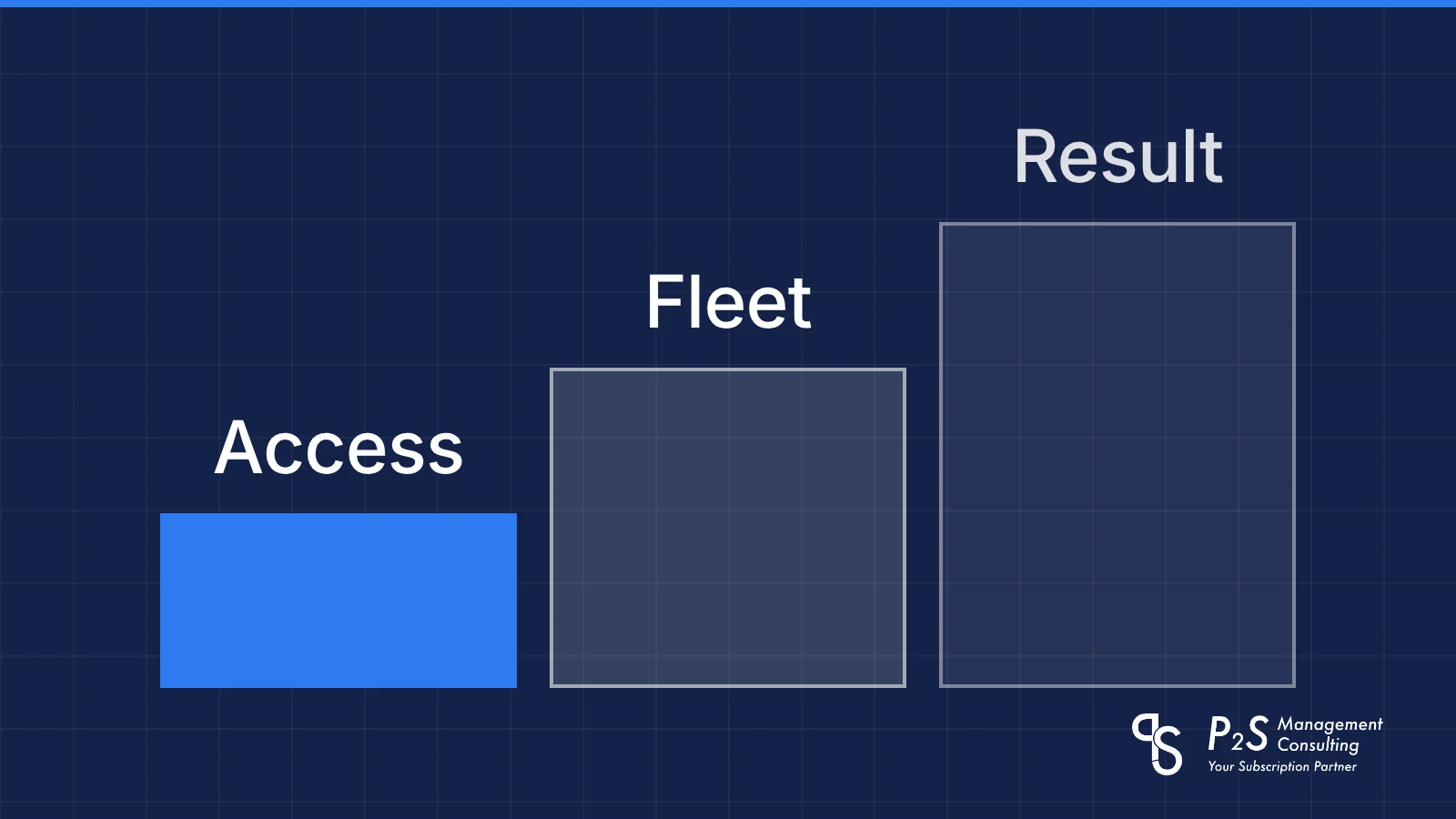
MedTech As-a-Service offers follow three overlapping patterns: technology access and readiness, savings and infrastructure outcomes for managed fleets and labs, and performance guarantees to the hospital or the payer.
| Technology access | Managed fleet with fee at risk | Guaranteed result | |
|---|---|---|---|
| What the hospital pays for | Current, maintained equipment it does not own | A fleet or lab run by one accountable partner | A defined operational, clinical or economic result |
| Payment mechanism | Per scan, per procedure, per patient or per month | Mostly fixed annual fee plus a KPI-linked share | Price tied to the result |
| Who signs | The hospital (value analysis committee, group purchasing organisation or tender) | The hospital, often at board level or by tender | The hospital, or the payer when the saving lands with the payer |
| Money at risk for the device maker | Lower: no fee at risk against KPIs, but under per-use pricing revenue falls when volume drops | Part of the fee, against KPIs such as uptime | A rebate or price reduction when the result is missed |
| Data needed | Usage and uptime telemetry | KPI data both sides trust | An agreed baseline, data owner and method; payer data for a payer contract |
| What the device maker has to control | Maintenance and response times on its own equipment | Service across the fleet, including suppliers it manages | Enough of the care pathway to influence the result, or a defined event it can insure |
The patterns share parts. An uptime commitment can appear in all three, and a managed fleet often bills part of its fee per use. What really separates them is whether money is at risk, and who captures the result. If the device maker loses part of its fee when a KPI is missed, the contract has moved from access to a managed fleet. If the hospital or an insurer keeps a measurable saving and the price depends on it, it is a guarantee.
Intuitive Surgical: paying per procedure on an installed platform
The problem. A surgical robot carries a very high upfront cost, which can tie a maker's revenue to the pace of new system sales.
The commitment. Intuitive sells instruments and accessories consumed per procedure, service contracts and operating leases alongside the capital sale. In 2025 it placed 1,721 da Vinci systems, 872 of them under operating leases and 496 of those under usage-based leases, in which the payment follows how much the system is used (Form 10-K).
The design decision. Earn most revenue per procedure on the installed platform, through instruments, service and, for some systems, usage-based leases. About 3,153,000 da Vinci procedures were performed in 2025, up about 18%, and instruments and accessories revenue grew by 19% to about 6.02 billion USD (Form 10-K).
The result. Recurring revenue reached 8.47 billion USD in FY2025 (about EUR 7.2 billion), 84% of total revenue, as reported in its Form 10-K. Intuitive defines recurring revenue as instruments and accessories, service and operating lease revenue. So Intuitive Surgical shows access economics, mostly earned per procedure, rather than a performance guarantee: its recurring revenue comes from instruments, service and leases, not from patient outcomes.
A smaller example shows access pricing in monitoring. In December 2019, Nihon Kohden announced US subscription pricing for its patient monitoring and neurology products: a flat monthly fee, a census-based fee or a per-patient fee, with no upfront fees for infrastructure, training or installation (company-announced).
The test that decides which model you can deliver
Two questions sort the models. First, can you measure the result independently, from a source both sides accept before the first invoice? Second, do you control the conditions that produce it?
Measurement has become more achievable: many connected devices already report usage and uptime, and predictive maintenance makes an uptime promise priceable. Control is the second place offers break. A scanner's throughput depends on hospital staffing, scheduling and referral volume. A fleet KPI depends on third-party equipment in the same department. A clinical result depends on case mix, the care pathway and how the payer codes the episode. Reimbursement and tariff changes can move the economics of any of the three during the term.
In our view, AI makes an outcome measurable. It does not make it contractable. An algorithm can count scans or flag a complication, but what to guarantee, what to exclude and who carries the risk when a tariff changes are commercial decisions. Our rule is short: guarantee what you control, write down what you do not, and agree who measures before you agree the price.
In our engagements, the most common failure we see is promising an outcome the device maker cannot measure. Run both tests on each device line, not on the portfolio as a whole, because a monitoring fleet and an implant will rarely pass the same test.
The figure turns the two tests into three questions: stop at the first one you cannot answer yes to.

What the business has to carry, and build
In access and managed-fleet contracts the asset usually stays with the device maker or a financing partner, so the balance sheet carries equipment that used to leave it on day one. Cash dips before it recovers, a shape known as the Fish Model. In MedTech the window is tight, because imaging systems are commonly depreciated over five to seven years, so the contract has to pay back within the device's life or include a planned refresh. Our page on financing and cash-flow structuring covers the funding paths.
The buyer side changes too. In the US a hospital or integrated delivery network usually buys through its value analysis committee and a group purchasing organisation; in Europe a hospital often buys by public tender. Technology access, managed fleets and guarantees whose result the hospital captures need only the hospital to say yes. A guarantee whose saving lands with the payer needs a contract with the payer.
Inside the company, three things have to be in place early: sales pay based on retention and margin rather than bookings before the first contract, telemetry the customer accepts as the source of truth before the first invoice, and billing that can invoice per scan or per patient without manual work before volume grows. Our position is that sales pay matters most: misaligned commissions are the main way a service offer is undermined from inside, because reps paid on unit sales can undercut it at the point of sale.
Where to start smaller
Our position: technology access is the right first move for most device makers, because it needs usage and uptime data and a yes from the hospital alone. Narrow further when the tests above are not yet passed:
- Start with one device line that already sends usage and uptime data, and keep the rest on capital terms.
- Fund the first contracts yourself. Our rule of thumb is three to five self-funded contracts to build the track record a financing partner will ask for.
- Leave clinical results out of the price until the population, the baseline and the exclusions are written down and both sides have accepted the measurement method.
In our view, a medical device company is ready to start offering equipment as a service when it can measure use and uptime continuously and fund the asset for the contract term. If one of the two is missing, one access contract on a single device line is a better start than a guarantee.
Frequently asked questions
Is Medical-Device-as-a-Service the same as leasing?
Not necessarily. Under IFRS 16, a contract is, or contains, a lease if it conveys the right to control the use of an identified asset for a period of time in exchange for consideration; ASC 842 applies the same test to identified property, plant or equipment. A contract is less likely to contain a lease when the supplier has a substantive right to substitute the asset throughout the term, or when the hospital does not direct how and for what purpose the asset is used. Bundling maintenance or software with the equipment does not by itself prevent lease treatment, because the lease and service parts are normally accounted for separately. The answer can change which budget pays at the hospital, so take accounting advice on the specific contract.
Do you need the payer in the contract?
Usually only when the saving lands with the payer. Access, managed fleets and hospital-facing guarantees are normally signed with the hospital, although a financing partner or a public funding body can also be involved.
What data do you need first?
Usage and uptime telemetry from the installed base, accepted in writing as the basis for the invoice. That is enough for technology access. A KPI-linked fee needs data both sides trust across the fleet, and a guarantee needs an agreed baseline and method before launch.
The decision for this year
In our view, most device makers do not need all three models. They need the one they can deliver, on the device line where the data and the control already exist. Name that line, the payment mechanism and the counterparty, and the first contract becomes a design task rather than a strategy debate.
Book a call with a partner to test which of your device lines could move to technology access first, and what would have to be true before part of the fee goes at risk. Book a call with a partner. For the full picture, the whitepaper adds the buyer and payer map for the US and Europe, six public cases, the six operating dimensions and a worked imaging example for your CFO: download As-a-Service for Medical Devices.
Related reading
- MedTech & Medical Devices at P2S
- Eligibility criteria for Equipment-as-a-Service
- IoT: a prerequisite for XaaS and subscription models
- Subscription business models for industrial manufacturers
- Philips: monetising high-value returns as a service (podcast)
Sources: Intuitive Surgical, Form 10-K for FY2025; Intuitive Surgical, preliminary fourth quarter and full year 2025 results; Nihon Kohden, subscription-based pricing for patient monitoring (11 December 2019); IAS Plus, IFRS 16 Leases summary; Deloitte DART, ASC 842 definition of a lease; ECB euro reference rates, 31 December 2025 (1 EUR = 1.1750 USD); P2S Management Consulting, As-a-Service for Medical Devices (2026).
