Key takeaways
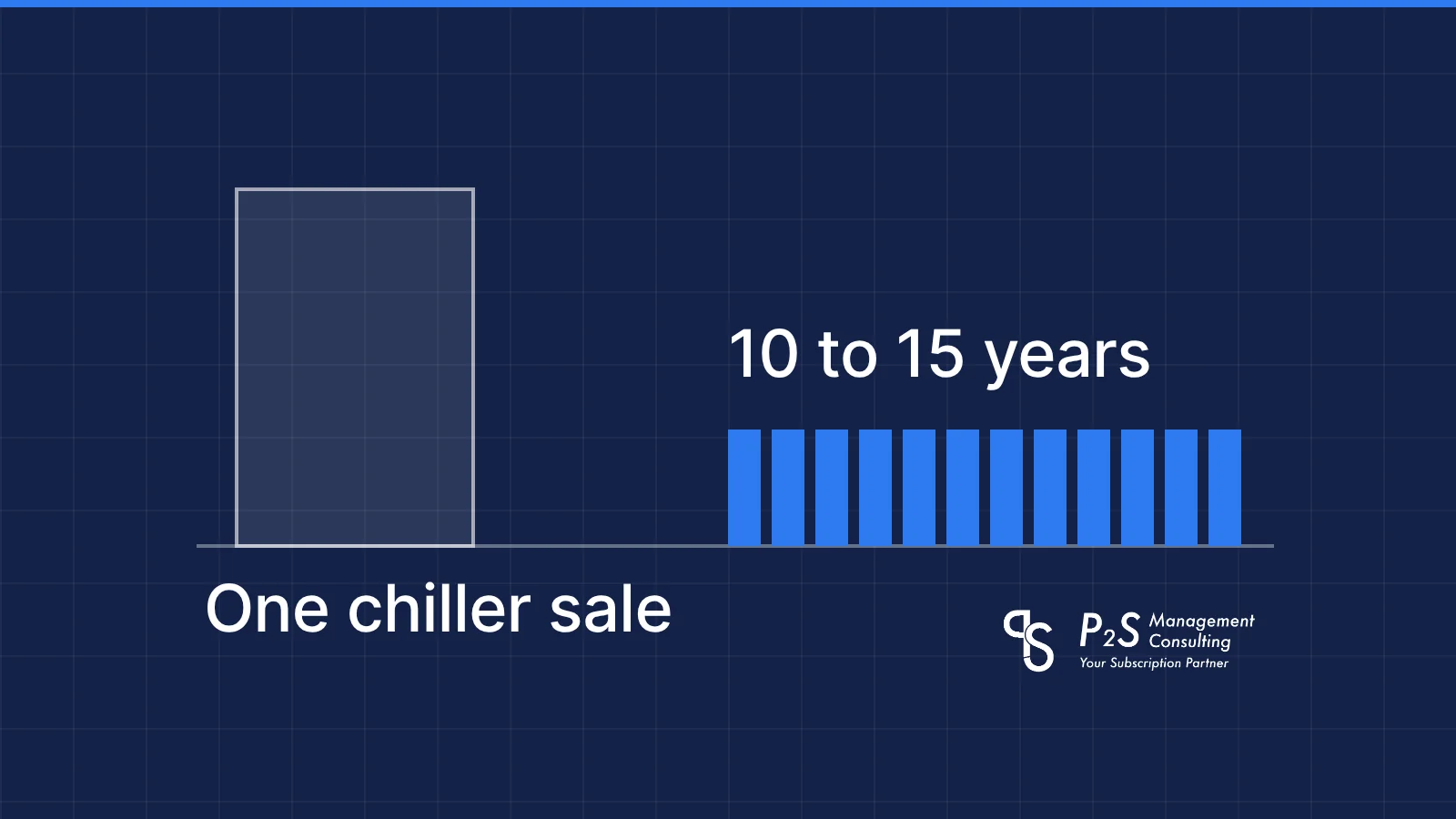
- For an HVAC maker, Cooling-as-a-Service can turn one chiller sale into 10 to 15 years of recurring revenue, and keeps the customer relationship with the party that runs the plant, instead of leaving it to an ESCO, an energy company or a fund.
- Bill on one unit the customer can budget and check: MWh of cooling delivered (refrigeration ton-hours), capacity held ready, floor area conditioned, or a fixed monthly fee.
- The provider or a partner usually funds and owns the plant, so decide early who funds the assets and what role installers and consulting engineers keep.
A chiller maker earns most of its money on the day the plant is sold. After that, the installer meets the specification, honours its warranty and moves on, and in the words of our whitepaper the product supplier ships a box. The plant then runs for years: the owner inherits the variance in its performance, and the maintenance contract goes to whoever holds the service relationship, rarely the maker.
Cooling-as-a-Service changes who holds it. The maker, or an integrator that owns the service relationship, keeps the plant, runs it and bills for the cooling it delivers. Our whitepaper Beyond the Thermostat sums up what P2S has learned from more than 500 industrial As-a-Service cases, and asks which HVAC outcomes a provider can actually put in a contract. For cooling, which providers such as Kaer have sold this way since 2013, the answer is well tested.
Why sell cooling instead of chillers
Replacement revenue thins out. In our view, better engineering weakens the equipment model: plant that is well built and well maintained lasts longer, so each installed unit produces fewer replacement orders, further apart. A cooling contract earns in each month the plant runs.
Recurring income compounds. Contracts turn lumpy project sales into predictable cash flow and build switching costs that hardware alone cannot match.
Someone else will take the customer. Our whitepaper warns that margin is migrating from hardware into software, lifecycle services, financing and performance accountability. The providers that have scaled Cooling-as-a-Service so far include Kaer in Asia, now backed by an infrastructure fund, and Energy Partners in South Africa, an industrial energy company rather than a chiller maker. A maker that waits may end up supplying chillers to the company that owns its customer.
The balance sheet changes. In Cooling-as-a-Service the provider, or a financing partner, owns the chillers instead of the customer, and one sale is replaced with income spread over the contract. The provider funds the plant and waits for its money; a maker that cannot carry that can bring in a capital partner to own the assets while it keeps the design, the operation and the guarantee. Our guide to financing and cash-flow structuring sets out the options.
The channel needs a new design. Carl Fredrik Sverdrup, a contributor to our whitepaper and former Chief Sales Officer of FläktGroup, estimates in it that roughly 80% of the European HVAC market runs through four parties: building owner, consulting engineer, installer and product supplier. Nobody in that chain answers for how the plant performs over 10 to 15 years. A maker that sells cooling direct steps into that gap, and risks a conflict with its own installers. Our position: keep installers as delivery partners, contracted by the provider and paid on how the contract performs, and ask consulting engineers to specify the outcome (capacity, availability, efficiency) rather than the equipment list.
The organisation needs new capabilities. Our whitepaper names six operating dimensions: one value metric, contract governance, financing, sales incentives, billing and IT, and performance data.
Cooling-as-a-Service, defined
Definition. Cooling-as-a-Service (CaaS) is a contract in which a provider designs, finances, installs, owns, operates and maintains the cooling plant at a customer's site, and the customer pays over a multi-year term for the cooling it receives or for guaranteed indoor conditions, instead of buying the equipment.
Unlike district cooling, where one network serves many buildings, CaaS generally covers the plant of one building or campus.
Four ways to sell the same plant
| Chiller sale with maintenance contract | Cooling-as-a-Service | Savings contract | Performance guarantee | |
|---|---|---|---|---|
| What the customer pays for | The equipment, then planned maintenance | Cooling delivered, or availability of defined indoor conditions | A share of verified savings, or a guaranteed reduction | Guaranteed operating performance in a critical zone |
| Typical value metric | Project price plus annual fee | Per MWh of cooling (refrigeration ton-hour), per kW per month, per m², or a fixed monthly fee | Shared savings against a baseline, kWh/m² reduction | Availability per service window, temperature and humidity precision |
| Who owns the plant | The customer | The provider or its financing partner | Usually the customer | Either |
| Who carries degradation and refrigerant risk | The customer, after warranty | The provider | Shared, by contract | The provider, within agreed exclusions |
| Data needed | Service records | Real-time energy monitoring and BMS integration | A verified baseline and consumption data | Continuous telemetry per zone |
| What the provider needs to control | Its own work | Plant operation and maintenance | The measures that create the savings | The plant, and the conditions written into the exclusions |
In practice the lines blur: a guarantee usually contains an availability promise, and a cooling contract can carry a savings element. Two things tell them apart. Does a missed promise trigger liquidated damages, and does payment depend on a baseline? Mixing those two logics in one contract is a trap: a month can meet the availability promise and miss the savings, and nobody can say what the invoice should be.
The case: Kaer and the price per refrigeration ton-hour
The customer problem. Owners of large commercial buildings face ageing chillers and rising energy costs, and many see cooling as non-core.
The commitment. Kaer moved to Cooling-as-a-Service in 2013. Customers buy cooling at a fixed rate per refrigeration ton-hour on a pay-as-you-use basis, with zero capital expenditure, and Kaer states that it assumes all financial and operational responsibility. At The Exchange TRX in Kuala Lumpur, its contract runs for 15 years, according to our case study.
The design decisions. The unit is cooling used, not equipment supplied. And a modular design avoids over-specified plant, so the owner does not pay for redundant capacity and the provider does not finance it.
The result. At INSEAD's Singapore campus, cooling energy use fell by 70% within six months (company-reported, via the Ellen MacArthur Foundation, which puts typical savings at 20%). In April 2025 TechNode reported that Kaer managed over S$200 million (about USD 152 million) of cooling assets serving over 1.85 million m² (20 million sq ft) of real estate across Asia, as PATRIZIA and Mitsui, through an infrastructure fund, took an initial minority stake targeting up to USD 350 million of capital deployment. INSEAD is one site at the top of the range, and the investment is capacity to fund future contracts, not revenue.
How a provider scales: Energy Partners
Energy Partners opened its first Cooling-as-a-Service plant in South Africa in 2015, and its 2025 brochure lists 20 MWR of installed refrigeration capacity (company-reported). In our reading, three choices stand behind that growth. It bills cooling on a tariff it describes as similar to other utilities, in kWh of refrigeration (kWhR) measured by its own meters, with fixed and variable parts. It wins second sites: in May 2024 it announced a second agreement with Sovereign Foods, for a R92 million (about USD 5 million) plant that Energy Partners funds in full and operates for 15 years. And it has capital in place, stating that its equity investments are backed by pre-approved construction and term facilities in excess of $150 million. Repeat business and committed funding, more than any single showcase plant, are what a maker can copy.
Four units you can bill cooling on
The unit decides who carries volume risk. Our whitepaper lists four for availability contracts:
- MWh of cooling delivered (refrigeration ton-hours; one MWh is about 284 ton-hours). The closest form of pay per use cooling: a hot summer raises revenue, a mild one lowers it.
- kW of capacity per month (per ton of refrigeration). Capacity held ready, whatever the customer draws.
- Square metre of conditioned space (per square foot). Simple for multi-tenant buildings, but it hides the load profile.
- A fixed monthly availability fee. The customer pays for the plant being ready; the provider carries any variation in use.

In engagements with Cooling-as-a-Service practitioners, we see the most successful availability models charge a fixed, known rate per unit of cooling delivered rather than billing on equipment runtime. The bill still moves with use. What the customer can predict is the rate, and it can check each invoice against a meter it trusts, which leaves less to dispute. Our guide to value metrics and metering covers the trade-offs.
The unit works when it carries the plant's costs for the whole term, not just the first years. Refrigerant rules sharpen this on both sides of the Atlantic: the EU F-gas Regulation restricts high-GWP refrigerants and phases down HFCs, and in the US the AIM Act authorises the EPA to phase down HFCs.
What the provider has to control
Precise metering does not help if someone else drives the load. Four questions come first:
- Load and occupancy. Who sets setpoints, opening hours and tenant fit-outs? Agree a trigger to resize or reprice when the building changes.
- The building envelope. Glazing, insulation and air leakage drive demand. If they are outside your scope, write them out of the promise.
- Third-party systems. Air handlers, controls or a BMS run by another contractor can undo the plant's efficiency.
- Power supply. Outages belong in the exclusions, which our page on risk allocation and guarantees covers.
Where to start smaller
A first contract does not need to cover the whole building:
- Meter one plant end to end, and bill the availability of that plant rather than comfort in each room.
- Leave the air side to its owner if the envelope and air handling are not yours.
- Bring in a capital partner if ten or fifteen years of funding is beyond your balance sheet today.
Without real-time monitoring and BMS access, sell maintenance first and build the data.
Frequently asked questions
Should an HVAC manufacturer offer Cooling-as-a-Service?
Yes, if it can meter the plant, fund it or find a partner who will, and keep its installers on side. Our whitepaper finds two positions that can carry the model: a manufacturer with a connected product stack, and an integrator that owns the service relationship. A maker that stays out leaves the recurring revenue and the customer to the other.
Is Cooling-as-a-Service the same as leasing a chiller?
Commercially, no. Under a lease the customer pays for the use of an asset and usually still runs it. In Cooling-as-a-Service the provider operates the plant and is paid for the cooling or availability it delivers, so efficiency loss, breakdowns and refrigerant replacement stay with the provider. In law and in the accounts, the classification follows the contract terms, not its name.
Who owns the chillers when the contract ends?
The contract should settle it before signing: an extension at a new rate, transfer to the building owner at an agreed value, or removal by the provider. Agree how components replaced during the term are valued, because they change what the remaining plant is worth. Each option can change how the contract is classified in law and in the accounts, and how the provider's title is protected while the plant sits in the customer's building, so take legal advice on it.
Choose the unit, then the first site
Moving from chillers to cooling is a decision about who owns the customer for the next fifteen years. Pick the unit you will bill on, the plant you can meter end to end and the partner who will carry the capital, then start with one site where the three line up.
Talk to a partner about which of your installed sites could move from chiller sales to Cooling-as-a-Service first. Book a call. For the three contract archetypes and the CEO checklist, download Beyond the Thermostat.
Related reading
- HVAC-as-a-Service and XaaS in building and construction
- Cooling-as-a-Service at TRX: Kaer's landmark project in Kuala Lumpur
- Podcast #1: from 0 to 100 million EUR in Cooling-as-a-Service
- Podcast #6: from selling chillers to selling cooling, with Kaer
- HVAC & Building Systems at P2S
Sources: Kaer, Cooling as a Service; Ellen MacArthur Foundation, Cooling as a Service: Kaer (2021); TechNode Global, PATRIZIA and Mitsui partner Kaer to accelerate CaaS expansion in Asia (16 April 2025); Energy Partners, CaaS brochure (2025); Energy Partners, From power hog to lean operation (12 November 2019); Energy Partners, Sovereign reaffirms commitment to Cooling-as-a-Service (13 May 2024); Energy Partners, About; US EPA, Protecting our climate by reducing use of HFCs; Regulation (EU) 2024/573 on fluorinated greenhouse gases; P2S Management Consulting, Cooling-as-a-Service at TRX case study; P2S Management Consulting, Beyond the Thermostat (2026). Rand and Singapore dollar figures converted at the rate on the date of each source.
