HVAC & Building Systems · 2026 · Flagship whitepaper

    Beyond the Thermostat.

    How HVAC and Building Systems win with outcome-based service models.

    The CEO's guide to turning climate performance into contractable outcomes, recurring revenue, and controlled risk.

    Book a call
    $280B+
    Global HVAC market · 2025
    6-7% CAGR - Markets and Markets, Fortune Business Insights
    40%
    Share of commercial building energy consumed by HVAC
    US Department of Energy
    2040
    EU deadline to phase out fossil fuel boilers
    Recast EPBD, European Commission

    About the research

    Cross-sector evidence from more than 500 industrial As-a-Service cases - not theory modelled from the outside.

    P2S Management Consulting draws on 500+ industrial As-a-Service cases across 12 industries. This whitepaper combines structured stakeholder interviews with HVAC operators at different stages of the outcome-based transition, thematic analysis across practitioner cases, and deep-dive consultations with C-levels, commercial leaders, and asset operators managing the financial and contractual architecture of service models in the building systems sector.

    All practitioner cases are anonymised in line with participant confidentiality agreements, except where the company is publicly known and the information cited is in the public domain. Market data is sourced from the International Energy Agency (IEA), Markets&Markets, Fortune Business Insights, the European Commission, and IoT Analytics.

    Scope definition

    By HVAC & Building Systems we mean the full range of actors who manufacture, distribute, install, own, operate, contract, or depend on heating, ventilation, air conditioning, and building climate infrastructure. This paper is written for two provider archetypes positioned to convert toward as-a-service models:

    1. HVAC product manufacturers who have embedded connectivity, controls, and software into their equipment (Daikin, Carrier, Trane, Danfoss, Systemair, Swegon, FläktGroup, and similar). The software layer is what carries them past the two-year warranty wall.
    2. Dealers and integrators who control the service relationship with the end customer - the actors closest to the building owner, with the technical depth to take single-point accountability across design, install, and operate.

    Executive summary

    The three archetypes - what every executive in HVAC & Building Systems needs to decide.

    Industrial markets are not moving uniformly toward subscription. They are moving toward contracted outcomes. For HVAC and Building Systems specifically - chillers, heat pumps, air handling units, building management systems, and the integrators, facility managers, and as-a-Service providers who deploy and contract these assets - the growth opportunity is no longer only in selling equipment or installing capacity. It is in turning climate performance into a commercially enforceable promise.

    The global HVAC market exceeded $280 billion in 2025 and is projected to grow at approximately 6-7% CAGR, yet equipment margins are compressing. Regulation is accelerating: the EU's recast EPBD, in force May 2024, requires renovation of the worst-performing 16% of non-residential buildings by 2030 and mandates a roadmap to phase out fossil fuel boilers by 2040. HVAC systems account for approximately 40% of total energy consumption in commercial buildings.

    But outcome-based models do not work by default. They work only when the outcome can be measured continuously, the technical and commercial risk can be priced correctly, and the financing structure fits the contract and the asset life. That creates the central question for every executive: which outcomes are truly contractable?

    P2S data signal

    Research across more than 500 industrial as-a-service cases consistently finds that providers who move from equipment sales to outcome-based contracts report deal values 2-3 times higher than equivalent CAPEX transactions, with significantly stronger customer retention and renewal economics. The model does not merely shift revenue timing. It changes the commercial relationship fundamentally.

    With thanks to Carl Fredrik Sverdrup - Industrial Platform Specialist with 30+ years in HVAC, ventilation, and industrial air movement across 30+ countries; Partner at Green Park Partners; former Chief Sales Officer at FläktGroup (2018-2024); former SVP Asia+ at Fläkt Woods Group.

    The structural question

    Where the model can work in the value chain.

    Most of the European HVAC market - roughly 80% - operates through a four-party value chain: building owner, consulting engineer, installer, product supplier. Nobody in that chain is single-point accountable for outcomes.

    Party 01
    Consulting engineer
    Designs but does not own performance.
    Party 02
    Installer / MEP
    Meets the spec, honours a two-year warranty, and walks.
    Party 03
    Product supplier
    Ships a box and exits.
    Party 04
    Building owner
    Inherits the variance.

    As-a-Service breaks because no one in the standard chain controls the operating system over a 10-15 year horizon. The model only works when one party collapses three roles - design, install, operate - under a single P&L. Every winning case in this paper sits in one of two positions: a manufacturer with a connected product stack, or an integrator who owns the service relationship. It is a structural requirement.

    The context

    Why product-only growth is under pressure.

    Four structural signals every executive in HVAC and Building Systems should track - reshaping competitive logic faster than most providers are adapting.

    Heat pump momentum · global sales index (2020 = 100)

    100110120130+27%202020212022202320242025e
    Heat pump momentum · global sales index (2020 = 100). Source: IEA Heat Pumps Report 2025.
    Signal 01

    Regulation is forcing building decarbonisation - and HVAC is the primary lever

    The EU's recast EPBD (in force 28 May 2024) requires renovation of the worst-performing 16% of non-residential floor area by 2030, rising to 26% by 2033; zero-emission for all new public buildings from 2028 and all new buildings from 2030; national roadmaps to phase out fossil fuel boilers by 2040; subsidies for standalone fossil fuel boilers prohibited from 2027. HVAC is ~40% of commercial building energy consumption - the single largest compliance lever.

    Signal 02

    Equipment is commoditising, but climate outcomes are not

    Global heat-pump sales rose 27% between 2020 and 2024 (IEA, 2025). In the US, heat pumps outsold natural-gas furnaces by 30% in 2024. Variable-speed centrifugal chillers now reach COPs above 6.0 part-load. The top five HVAC manufacturers hold 25-30% share and are all investing in software, digital services, and outcome-based commercial models to differentiate beyond hardware.

    Signal 03

    HVAC is now the building's operating system, not a utility afterthought

    IoT Analytics' 2025 State of IoT estimates connected IoT devices reach 21.1B by end-2025, 39B by 2030, and exceed 50B by 2035. Connected HVAC generates continuous streams of energy, IAQ, temperature, health, and occupancy data - making outcome verification technically feasible at scale.

    Signal 04

    Buyers want climate outcomes, not equipment ownership headaches

    Owners and occupiers prefer lower upfront commitment, faster procurement, and clearer accountability. Shifting CAPEX to OPEX bypasses internal investment hurdles and transfers operational complexity to the provider. The EU F-gas phasedown (Kigali Amendment) adds technical complexity buyers would rather outsource than manage.

    Implication

    The strategic risk for as-a-Service providers in HVAC is not missing growth. It is scaling hardware volume while margin migrates into software, lifecycle services, financing, and performance accountability. Providers who do not capture that shift will find themselves competing on price in a commodity market they helped build.

    Three segments

    One is out of scope, two are in play.

    The €80B European HVAC market splits roughly into three segments. Residential is out of scope for this paper. Commercial and industrial are both in play, with different mechanics.

    The €80B European HVAC market · share by segment

    ~30%
    ~50%
    ~20%

    Share of market

    Out of scope
    Residential (~30%)
    In play
    Commercial (~50%)
    Core opportunity
    In play
    Industry & Infrastructure (~20%)
    Strong fit, different mechanics
    Segment split across the European HVAC market.
    Segment 01
    Out of scope

    Residential (~30%)

    Fragmented end-customers, low-asset-value installations, and difficult collections economics make unit-level as-a-service operationally hard. Apartment-block aggregation models exist but are early-stage.

    Segment 02
    Core opportunity

    Commercial (~50%)

    Hotels, hospitals, universities, public swimming pools, multi-site retail, large logistics warehouses, corporate campuses, and commercial refrigeration in food retail and cold-chain. Works where energy intensity, an EPBD/sustainability driver, and a single decision-making owner converge.

    Segment 03
    Strong fit, different mechanics

    Industry & Infrastructure (~20%)

    Data centres, pharma, food processing, refineries. Capital-strong buyers who don't need the financing wrapper but want technical specificity (explosion-proof, GMP, cleanroom) and risk transfer on uptime. Contract value is driven by performance guarantees, not OPEX conversion.

    The engine

    The architecture of a contractable outcome.

    Why the stack matters more than the contract. Outcome-based models are not pricing models - they are system designs. The promise only works when hardware, software, service, verification, and governance all support the commercial commitment simultaneously.

    P2S research across 500+ cases finds that providers who skip the governance and verification layers to accelerate deployment consistently encounter the same outcome: billing disputes, margin leakage, and contract renegotiation within 18 months.

    The outcome stack · five layers

    GovernanceLayer 5
    VerificationLayer 4
    ServicesLayer 3
    SoftwareLayer 2
    HardwareLayer 1
    System design
    Commercial guardrailsPhysical foundation
    The outcome stack - five layers that must be designed together.
    L5

    Governance

    The commercial guardrails: KPIs, SLAs, exclusions, liability caps, baseline definitions, repricing triggers, occupancy adjustment, margin dashboards.

    L4

    Verification

    The source of truth: sub-metering, energy dashboards, indoor air quality sensors, audit logic that prove the promised outcome was delivered.

    L3

    Services

    The operational layer: commissioning, preventive and predictive maintenance, emergency response, refrigerant management, retrofit, decommissioning.

    L2

    Software

    The digital brain: BMS, energy management platforms, AI-driven optimisation, fault detection and diagnostics, occupancy analytics, demand response.

    L1

    Hardware

    The physical system: chillers, heat pumps, boilers, AHUs, cooling towers, fan coils, thermal storage, refrigerant circuits, building integration.

    CEO message

    Do not treat As-a-Service as a commercial wrapper placed over an existing product. Treat it as a full-stack operating model. Each layer must be designed before the first contract is signed.

    The triple win

    The model scales when all three sides win.

    When any one of the three sides loses, the model either fails commercially or fails to scale. When all three win simultaneously, it builds switching costs and retention that hardware sales cannot replicate.

    Three sides that must win at the same time

    01For As-a-Service providers
    • ·Stable recurring revenue
    • ·Strategic differentiation
    • ·Enhanced loyalty
    02For customers
    • ·CAPEX to OPEX shift
    • ·Risk transfer
    • ·Future-proofing
    03For the grid and planet
    • ·Asset longevity
    • ·Circular economy
    • ·Grid stability
    The model scales only when all three sides win

    For As-a-Service providers

    • Stable recurring revenue
      Flatten lumpy project sales into predictable, compounding cash flows.
    • Strategic differentiation
      Compete on guaranteed performance and risk transfer, not hardware price.
    • Enhanced loyalty
      Shift from transactional vendor to indispensable operating partner.

    For customers

    • CAPEX to OPEX shift
      Bypass internal investment hurdles. Preserve core capital for business operations.
    • Risk transfer
      Outsource operational, maintenance, refrigerant, and obsolescence risk.
    • Future-proofing
      Continuous access to software upgrades, technical improvements, and managed performance.

    For the grid and planet

    • Asset longevity
      Providers are financially incentivised to maximise equipment health and useful life.
    • Circular economy
      Refrigerant stewardship, component reuse, and organised decommissioning become manageable at scale.
    • Grid stability
      Optimised HVAC reduces building energy and carbon emissions, accelerating net-zero targets.

    The three archetypes

    Three commercial archetypes that actually work.

    Each archetype demands a different contractual architecture, financing logic, and operational depth. Choosing the wrong archetype for the buyer - or worse, promising an archetype you cannot measure - is the most common failure mode P2S encounters in the field.

    Three commercial archetypes · increasing risk transfer

    01
    Comfort & climate availability
    Readiness
    $/RTH · kW · m² conditioned
    02
    Energy savings & building outcomes
    Outcomes
    Savings · kWh/m² · compliance
    03
    Performance guarantees
    Uptime
    99.x% availability · liquidated damages

    Increasing risk transfer · contract value · governance demand

    The three commercial archetypes across HVAC & Building Systems.
    01
    Archetype

    Comfort & climate availability

    How it shows up in chillers, heat pumps, and building climate services.

    The customer pays for climate readiness, not equipment ownership. Typically per refrigeration ton-hour, per kW of cooling/heating capacity, or a guaranteed indoor climate condition. The provider designs, finances, installs, owns, operates, and maintains the equipment.

    Best for
    Commercial offices, retail, education, hospitality, industrial facilities - where climate availability matters more than ownership.
    Value metrics
    $/RTH · per kW capacity per month · per m² of conditioned space · fixed monthly availability fee.
    Core value
    Shields the buyer from lifecycle risk. End-of-life replacement, refrigerant phase-downs, efficiency degradation - all absorbed by the provider.
    Data requirement
    Real-time energy monitoring and BMS integration. Without a single source of truth, availability cannot be priced or governed accurately.

    P2S practitioner insight

    The most successful availability models use consumption-based pricing ($/RTH) rather than variable equipment-runtime billing. Customers prefer predictability; providers reduce billing variability and dispute risk. One CaaS pioneer described the shift from equipment-based to output-based pricing as the single most important commercial design decision they made - their model requires 20-30% less hardware than traditional installations.

    CEO watch-out

    If lifecycle and utilisation risk is not priced and governed explicitly, margin leakage becomes structural. In HVAC, leakage rarely starts with discounting - it starts with degradation assumptions that were never stress-tested, or refrigerant replacement costs that were never priced in.

    02
    Archetype

    Energy savings & building outcomes

    How it shows up in energy performance contracts, retrofits, and managed campus services.

    The customer pays for a defined operating or economic result - verified energy savings, regulatory compliance, or a guaranteed reduction in building energy intensity - rather than for the equipment itself.

    Best for
    Commercial buildings under major renovation, corporate campuses with sustainability targets, institutional buildings, owners facing EPBD minimum energy performance standards.
    Value metrics
    Per site per month · shared savings against a verified baseline · guaranteed kWh/m² reduction · target energy performance class · carbon reduction certificates.
    Regulatory angle
    For owners facing EPBD deadlines (worst-performing 16% renovated by 2030), the model is strategically attractive - provided baseline definitions, verified measurement, and adjustment rules are agreed before signing.
    Key risk
    Mixing shared-savings with performance-guarantee logic in the same contract. One depends on verified baseline and consumption; the other on system uptime. Conflating them creates irresolvable billing disputes.

    P2S practitioner insight

    One provider deliberately moved away from shared savings because it introduced disputes about actual versus projected savings. They shifted to consumption-based, three-component pricing: monthly availability fee + monthly maintenance fee + variable charge on verified consumption. Contract terms 10-20 years.

    Pricing architecture · three components

    A commercially scalable model for building savings & outcomes. Contract terms typically 10-20 years, aligned with expected asset lifecycle.

    Fixed
    Availability fee
    Monthly
    Fixed
    Maintenance fee
    Monthly
    Variable
    Verified consumption
    Per-unit charge

    CEO watch-out

    Do not promise savings unless you have a clean baseline and a credible verification methodology in place before contract. In HVAC, baselines are vulnerable to occupancy, weather, and usage shifts - all must be addressed in the contract methodology. Public-sector procurement adds friction: most tenders are still CAPEX awards, not multi-year OPEX commitments.

    03
    Archetype

    Performance guarantees

    How it shows up in critical environments - data centres, hospitals, high-stakes operations.

    The customer pays for guaranteed operating performance under defined conditions. This is the highest-value archetype and the most contractually demanding. The provider is no longer selling service effort - it is selling downside risk transfer.

    Best for
    Data centres, hospitals, pharmaceutical production, cleanrooms, financial institutions - where HVAC failure has immediate economic, regulatory, or safety consequences.
    Value metrics
    Availability % by service window (e.g. 99.8% uptime) · response/restoration time · temperature and humidity precision thresholds · IAQ floors · liquidated damages.
    Core value
    Risk transfer. Operational confidence. One accountable party for climate performance across the full contract life.
    Contract requirement
    Defined Force Majeure and site-readiness exclusions must be explicit and agreed before signing. Without them, providers absorb penalties for outages, building-fabric failures, and external events they did not cause.

    P2S practitioner insight

    Johnson Controls OpenBlue delivers guaranteed outcomes for Net Zero, Infrastructure and Buildings as a Service - customers pay for expected outcomes, not assets - including a 40-year concession with the University of North Dakota. Trane Technologies, a DOE-qualified ESCO, has delivered $3.6B in guaranteed energy savings with typical ESPC-to-CAPEX multiples of 2.5×.

    Proof point
    Johnson Controls OpenBlue
    Guaranteed asset performance
    100k+
    Global service experts
    2022
    First dedicated IAQaaS
    Proof point
    Trane Technologies
    Energy Savings Performance Contracting
    $3.6B
    Guaranteed energy savings delivered
    2.5×
    Typical ESPC-to-CAPEX multiple

    CEO watch-out

    This is not a standard service contract - it is an insurance-like promise. In performance guarantees for critical environments, the gap between a maintenance SLA and a performance guarantee can represent a 2-3× difference in contract value - and an equivalent jump in liability if exclusions are poorly drafted.

    Margin economics

    What creates margin - and what quietly leaks it.

    Recurring billing alone does not create margin. Margin shifts to the player that can measure, contract, finance, and operate the outcome better than competitors.

    Margin created by

    • Risk transfer and performance accountability
    • Lifecycle monetisation over the asset life
    • Software-enabled optimisation and fault detection
    • Customer switching costs and high retention
    • Capital efficiency for the building owner

    Margin at risk from

    • Underpriced degradation and refrigerant replacement assumptions
    • Weak contract boundaries and open-ended liability
    • Poor metering quality and disputed billing data
    • Manual billing processes that cannot scale
    • Financing structures misaligned with contract tenors
    • Sales incentives rewarding booking volume over contract health

    Six recurring margin risks in HVAC service models.

    01

    Underpriced technical risk

    Efficiency degradation, refrigerant replacement, and equipment lifecycle assumptions modelled at best-case rather than field-case. Mid-life overhaul (years 8-12) is the most commonly underpriced cost in long-term climate contracts.

    02

    Weak contract boundaries

    Outcome language not paired with strict scope, occupancy adjustment, and force majeure exclusions. Every unclear boundary between the provider's system and the building envelope eventually becomes a dispute.

    03

    Poor metering quality

    Disputes about savings or performance are almost always disputes about whose data is authoritative. A contested source of truth destroys margin and trust simultaneously.

    04

    Manual billing processes

    Cannot handle large portfolios of buildings with variable monthly invoices without significant headcount - eliminating the margin benefit of scale.

    05

    Financing mismatches

    HVAC lifecycles of 15-25 years require matching long-tenor debt. Mismatched tenors create cash-flow gaps and balance-sheet pressure.

    06

    Misaligned sales incentives

    Teams undercut subscription offers with CAPEX alternatives to hit short-term booking targets. Commission structures must be redesigned in parallel with the commercial model, not after it has stalled.

    Real-world evidence

    Who is winning, and why.

    Six practitioner cases from P2S primary research and public sources. Patterns are consistent across sectors and geographies.

    KAER
    Commercial & Industrial Cooling · Asia
    Cooling-as-a-Service · Archetype 01
    Strategic friction

    Commercial owners face aging chillers, rising energy costs, and sustainability pressure. Upfront capital of $2-10M for a large building is the adoption barrier.

    Outcome-based offer

    Fixed $/RTH pay-as-you-use. Kaer designs, finances, installs, owns, monitors, and operates the entire chilled-water plant. At INSEAD Singapore, cooling energy consumption fell 70% within six months. Kaer manages $200M+ of CaaS assets across 10M+ sq ft, 10-15-year contracts.

    Key lesson

    Availability models work when the provider can monitor asset condition well enough to price lifecycle risk with confidence. The AI/IoT layer is the contractual protection mechanism, not a product feature - CaaS installs require 20-30% less hardware because real-world data eliminates over-specification.

    ENERGY PARTNERS
    Industrial Refrigeration · South Africa
    Cooling-as-a-Service · Archetype 01
    Strategic friction

    Industrial and food operators face aging refrigeration, unreliable grid power, and capital constraints. Energy instability plus high CAPEX for modern ammonia systems make outsourced cooling compelling.

    Outcome-based offer

    EP invests 100% of capital and operates the plant up to 15 years. Sovereign (poultry): ~$5M in 5.47 MWR ammonia with 20% energy savings. Clover SA (dairy): $20M in 10 MW plant with 1.6 MW solar. Now building South Africa's largest ammonia plant for Aspen Pharmacare under a $16M CaaS deal targeting 40% energy reduction and 10× higher EBITDA margins.

    Key lesson

    CaaS is primarily a risk-transfer product, not merely a financing mechanism. Digital twins and 24/7 remote monitoring enable a proactive efficiency approach that manual operation cannot replicate.

    CARRIER
    Building Systems · Global
    Indoor Air Quality & Energy Outcomes · Archetype 02
    Strategic friction

    Post-pandemic, occupiers demand verified IAQ alongside energy efficiency. Owners lack in-house expertise to deliver and verify both simultaneously.

    Outcome-based offer

    Healthy Buildings Programme integrates HVAC, IAQ, fire & security, and digital BMS into outcome-based service. Abound (digital platform) plus the equipment portfolio delivers verified building health and energy outcomes under managed service agreements.

    Key lesson

    IAQ + energy efficiency creates a compound outcome commanding a measurable premium. MIT research finds wellness-certified buildings achieve up to 7.7% higher effective rents; certified properties see a 5-9% occupancy advantage.

    DAIKIN
    HVAC Manufacturing · Europe & Asia
    Climate-as-a-Service · Archetype 02
    Strategic friction

    As the world's largest HVAC manufacturer, Daikin faces the paradox of hardware commoditisation - leading technology does not guarantee leading margin. Owners increasingly compare on total cost of ownership and guaranteed performance.

    Outcome-based offer

    Progressive subscription/as-a-service across the commercial portfolio, leveraging vertically integrated manufacturing and an expanding digital services platform. Combines heat-pump and VRF leadership with remote monitoring, predictive maintenance, and energy optimisation. The 2023 acquisition of Alliance Air Products expanded managed-service reach.

    Key lesson

    Providers who control the full stack - equipment, digital platform, service network - gain a visible pricing advantage. Daikin's commercial maintenance attach rates exceed 60% for large projects, letting them price lifecycle risk with greater confidence than assemblers of third-party components.

    ADVEN
    Industrial & Real Estate Energy · Nordics, Baltics, Central Europe
    Energy-as-a-Service · Archetype 02
    Strategic friction

    Industrial sites, municipalities and property owners need to decarbonise heating without heavy upfront CAPEX or operating specialised energy infrastructure themselves.

    Outcome-based offer

    Adven invests in, owns, develops and operates clients' energy production facilities under long-term partnerships - district heating, geoenergy, steam, heat, cooling and water treatment for industrial and real estate. Operates 100+ district-heating networks across Sweden, Finland, Estonia and Latvia.

    Key lesson

    The strategic opportunity is not only selling equipment or installation - it is moving up the value chain by taking accountability for delivered thermal outcomes. The buyer's pain point is achieving lower-carbon, reliable, cost-predictable heating and cooling without added operational complexity or CAPEX.

    DANFOSS
    Climate Solutions · Global
    Performance-based Efficiency · Archetype 03
    Strategic friction

    Commercial buildings run HVAC that consumes 40-60% more energy than necessary due to suboptimal control, poor commissioning, and lack of continuous optimisation. Owners know efficiency is available but lack the operational capability to capture it.

    Outcome-based offer

    Intelligent HVAC components (drives, EEVs, sensors) combined with the Leanheat AI platform for building energy optimisation. Powered by 10+ years of real-time data across 6,000+ buildings, Leanheat saves 180,000 MWh annually and reduces peak loads by up to 20%. Being deployed across 50,000 housing units with enercity AG in Hanover, achieving 5-10% consumption reduction.

    Key lesson

    Component manufacturers who embed intelligence into their products create the data infrastructure that enables system-level performance guarantees. Danfoss's dual position - component supplier and digital services provider, reinforced by its strategic investment in Aneo Retail for food-retail EaaS - shows how the enabling technology layer can become the foundation for outcome-based commercial models.

    The pattern across all six cases

    Measure
    BMS telemetry
    Independent, auditable source of truth
    Contract
    Clean baselines
    Adjustment rules, exclusions, F.M.
    Deliver
    Full delivery chain
    Design · finance · build · operate all owned
    Finance
    Long-tenor capital
    15-25 year tenor aligned to asset life
    Scale
    Playbook + incentives
    Repeatable contracts + commercial model

    Every winning case combined all five. Skip one and margin, retention, or scale breaks.

    The operational shift

    Most As-a-Service failures are operating-model failures.

    Moving to outcome-based models is a change in operating DNA - not a pricing change. Six dimensions that need to be designed together.

    Six dimensions · and the order they must be designed in

    Prerequisite
    Value proposition, bundling & pricing
    01
    Prerequisite
    Legal, governance & risk
    02
    At scale
    Financing & strategic accounting
    03
    Prerequisite
    Sales motion, culture & incentives
    04
    Before renewal
    IT infrastructure & billing automation
    05
    In parallel
    Digitalisation, data & performance
    06
    Prerequisite · before the first contract
    Starts self-funded · external capital at scale
    Validated before the first renewal cycle
    Built in parallel with the pilot
    The six dimensions of the outcome-based operating model.
    01

    Value proposition, bundling & pricing

    • ·Define one clear customer value metric before anything else.
    • ·In HVAC, decide: $/RTH, $/kWh saved, $/m² conditioned, or availability %.
    • ·Establish discount discipline and renewal mechanics before the first contract.
    02

    Legal, governance & risk

    • ·Build SLA structures, verification rules, and contractual remedies.
    • ·Define occupancy adjustment, weather normalisation, and force majeure exclusions.
    • ·Monitor margin drift and compliance across the portfolio.
    03

    Financing & strategic accounting

    • ·Define the capital path: on-balance-sheet, external debt, or SPV.
    • ·Align cash-flow logic with contract duration and 15-25-year asset life.
    • ·Self-fund the first 3-5 projects before engaging external partners.
    04

    Sales motion, culture & incentives

    • ·Adapt the sales narrative from equipment specs to building outcomes.
    • ·Align incentives with contract health, retention, and realised margin.
    • ·Misaligned commissions are the primary internal sabotage mechanism.
    05

    IT infrastructure & billing automation

    • ·Verify CRM, ERP, billing, and contract-management readiness.
    • ·Build usage-to-invoice workflows and automated reporting logic.
    • ·Manual billing cannot handle large building portfolios at scale.
    06

    Digitalisation, data & performance

    • ·Make the promised outcome measurable, auditable, and manageable.
    • ·Build KPI dashboards, BMS integration, energy reporting flows.
    • ·The digital backbone must be in place before the first invoice.

    Sequencing guidance

    Dimensions 1, 2, and 4 (value proposition, legal governance, sales incentives) are non-negotiable prerequisites - addressed before the first contract is signed. Dimension 3 (financing) starts self-funded; external debt or SPVs come at scale. Dimension 5 (IT & billing) must be validated before the first renewal cycle. Dimension 6 (digital backbone) is built in parallel with the pilot. Retrofitting any of these after scale creates exactly the operational and margin problems the model was designed to avoid.

    The CEO decision checklist

    From first deal to full scale.

    Four phases. Six CEO-level decisions that cannot be delegated. The sequence matters as much as the decisions.

    Phase 1 · Build the case

    Decision 1 - The Outcome
    Approve the primary value metric: $/RTH, guaranteed indoor temperature band, availability %, kWh/m² reduction, or IAQ threshold. Define the boundary precisely.

    Phase 2 · Shape the model

    Decision 2 - The Risk
    Set non-negotiable exclusions. Approve liability caps. Explicitly approve refrigerant replacement, occupancy, weather, and building-fabric assumptions before first issue.
    Decision 3 - The Funding (pilot)
    Select the initial capital path. The pilot is typically self-funded - it builds the track record external partners require.

    Phase 3 · Implement

    Decision 4 - The Truth
    Approve the source of truth: metering, BMS integration, dashboards, audit trail. Sub-metering and independent verification must be contractually non-negotiable.
    Decision 5 - The Infrastructure
    Approve the IT, billing, and BMS integration investment before volume scales. Managing outcome contracts in legacy infrastructure is operationally intensive and error-prone.

    Phase 4 · Scale

    Decision 3 - The Funding (scale)
    Once the pilot track record is established, approve the external capital structure: structured debt, SPV, or balance sheet. SPVs become viable at $30-$50M deployed.
    Decision 6 - The Alignment
    Approve the sales incentive plan. Reward contract health, realised margin, retention - not booking volume. Redesign commissions in parallel with the commercial model.

    Before scaling, the CEO should be able to confirm all five

    • We can measure the promised climate outcome reliably and continuously.
    • We control enough of the delivery chain to influence the result.
    • We have priced the technical risk rather than assumed it away.
    • Our financing matches the contract and asset-life reality.
    • Our systems and incentives can scale the model without hidden margin leakage.

    Next steps

    How P2S helps.

    Four types of support - available at any stage. Not sequential. You may need several at once.

    Educate

    When your leadership needs to understand what outcome-based HVAC models really require before committing.

    Executive briefings, industry playbooks, and readiness assessments - grounded in real case data from 500+ industrial transitions, not theory.

    Advocate

    When the idea exists but lacks executive buy-in or cross-functional support to move forward.

    Frame the investment case for the board, map decision-makers across commercial, technical, and finance, and build cross-functional consensus.

    Facilitate

    When you are ready to move from concept to reality and need hands-on execution support.

    We co-create the offer, pricing, contracts, delivery logic and financing path - and close the first deal alongside your team.

    Professionalise

    When the model works but your organisation needs to own it, replicate it, and scale it independently.

    Transfer knowledge, build internal tools and methods, train commercial and operational teams, and create a repeatable playbook for scaling.

    Book a call

    Appendix

    Financing the transition.

    The shift from CAPEX sales to outcome-based contracts changes the provider's cash-flow profile materially. A CAPEX transaction delivers a large upfront booking with limited recurring revenue. An outcome-based contract requires upfront investment in asset financing and operational infrastructure, with recurring revenue that builds over time.

    This cash-flow pattern is known as the Fish Model. The initial dip below the CAPEX baseline - the body of the fish - is temporary, but the recurring revenue tail is structurally more durable and valuable than any single transaction. The crossover point typically occurs between four and seven years, depending on contract size, financing structure, and cost-to-serve efficiency. The Fish Model is manageable - not a reason to avoid the transition, but a financing design challenge to solve.

    The Fish Model · revenue & cost transformation

    Transformation timeRevenueCostsFaster revenue growthLower labour costsImpact of investments in the new capabilitiesImpact of transitioning to a consumption pricing model

    Technology-as-a-Service Playbook 2016 (TSIA), adapted.

    The Fish Model - the crossover typically occurs between years four and seven.
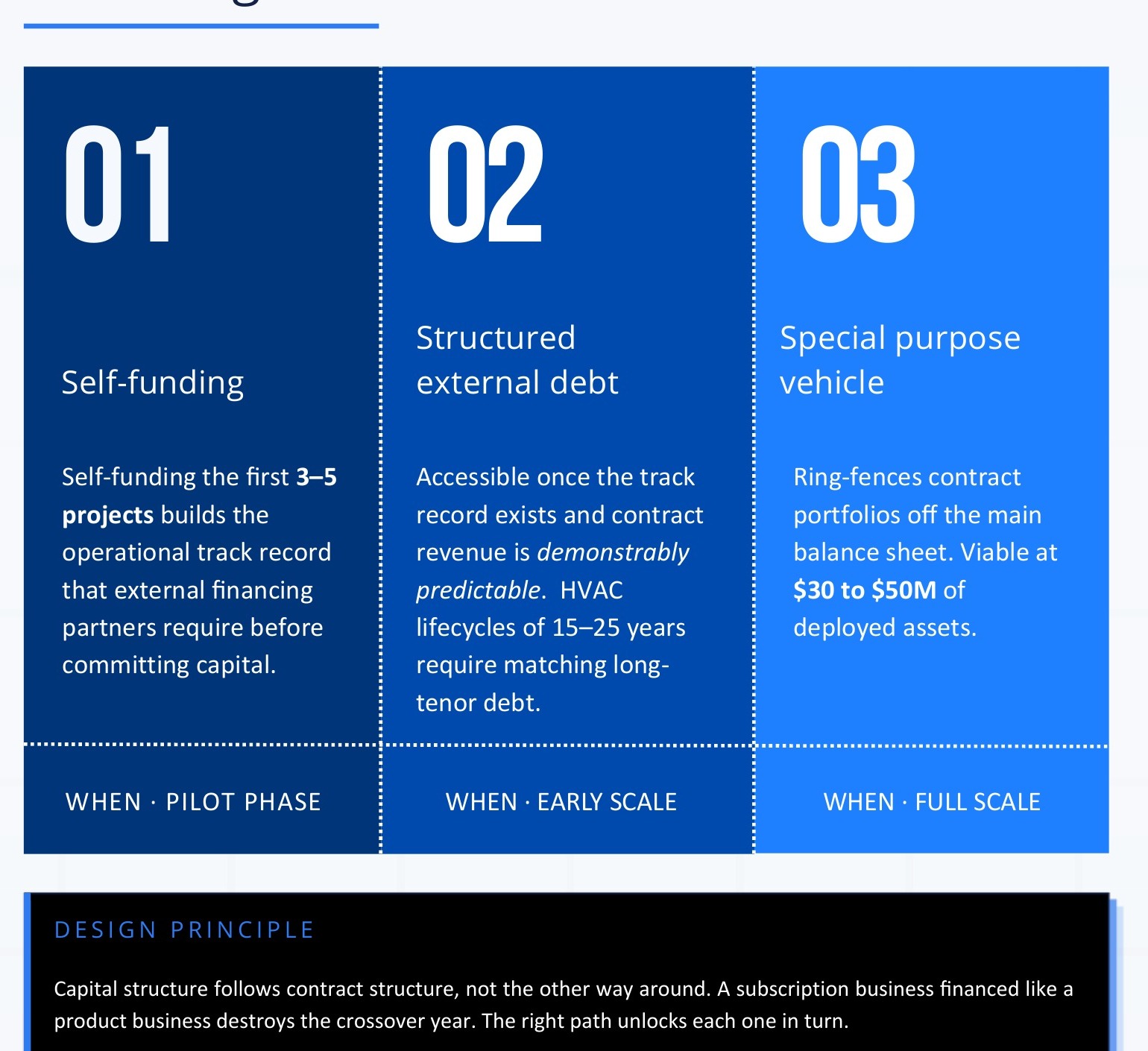
    01
    When · Pilot phase

    Self-funding

    Self-funding the first 3-5 projects builds the operational track record that external financing partners require before committing capital.

    02
    When · Early scale

    Structured external debt

    Accessible once the track record exists and contract revenue is demonstrably predictable. HVAC lifecycles of 15-25 years require matching long-tenor debt.

    03
    When · Full scale

    Special purpose vehicle

    Ring-fences contract portfolios off the main balance sheet. Viable at $30-$50M of deployed assets.

    Design principle

    Capital structure follows contract structure, not the other way around. A subscription business financed like a product business destroys the crossover year. The right path unlocks each one in turn.

    HVAC & Building Systems 2026

    Let's talk about your outcome-based model.

    In a world where resource scarcity is becoming a structural reality, we believe the shift from ownership to usership helps optimise resource utilisation and support more resilient industrial systems. Western industrial firms must accelerate their transition towards service-driven and more circular business models. P2S exists to support industrial firms in that transition.

    Book a call

    Ready to explore your next recurring-revenue or As-a-Service move?

    We'll help you assess the opportunity, spot the risks, and define the most credible next step.

    Book a call
    Book a call