Key takeaways
- A non-wires alternative turns a battery into a multi-year capacity contract with a network operator, and in our view whoever holds that contract keeps the operator relationship and the recurring payments.
- The network operator pays for capacity it can call in defined windows, so dispatch priority, the delivery test and the remedies decide your margin more than the headline price.
- Treat stacked market revenue as upside: the operator's call comes first, and it may take a share of what the battery earns elsewhere.
A distribution network operator facing an overloaded substation has two ways out. It can reinforce the network, which takes capital and years, or contract flexible capacity near the constraint while the peak lasts. Non-wires alternatives are the second way out. For battery makers, and for the integrators who design, install and service storage sites, the question is commercial: bid for a network operator's capacity need yourself, join someone else's bid, or supply whoever wins?
Our whitepaper Beyond the Meter, which distils what P2S has learned from more than 500 industrial As-a-Service cases, treats network operators as buyers of contracted availability. We follow it into one public contract in New York.
Why bid for a network operator's capacity need
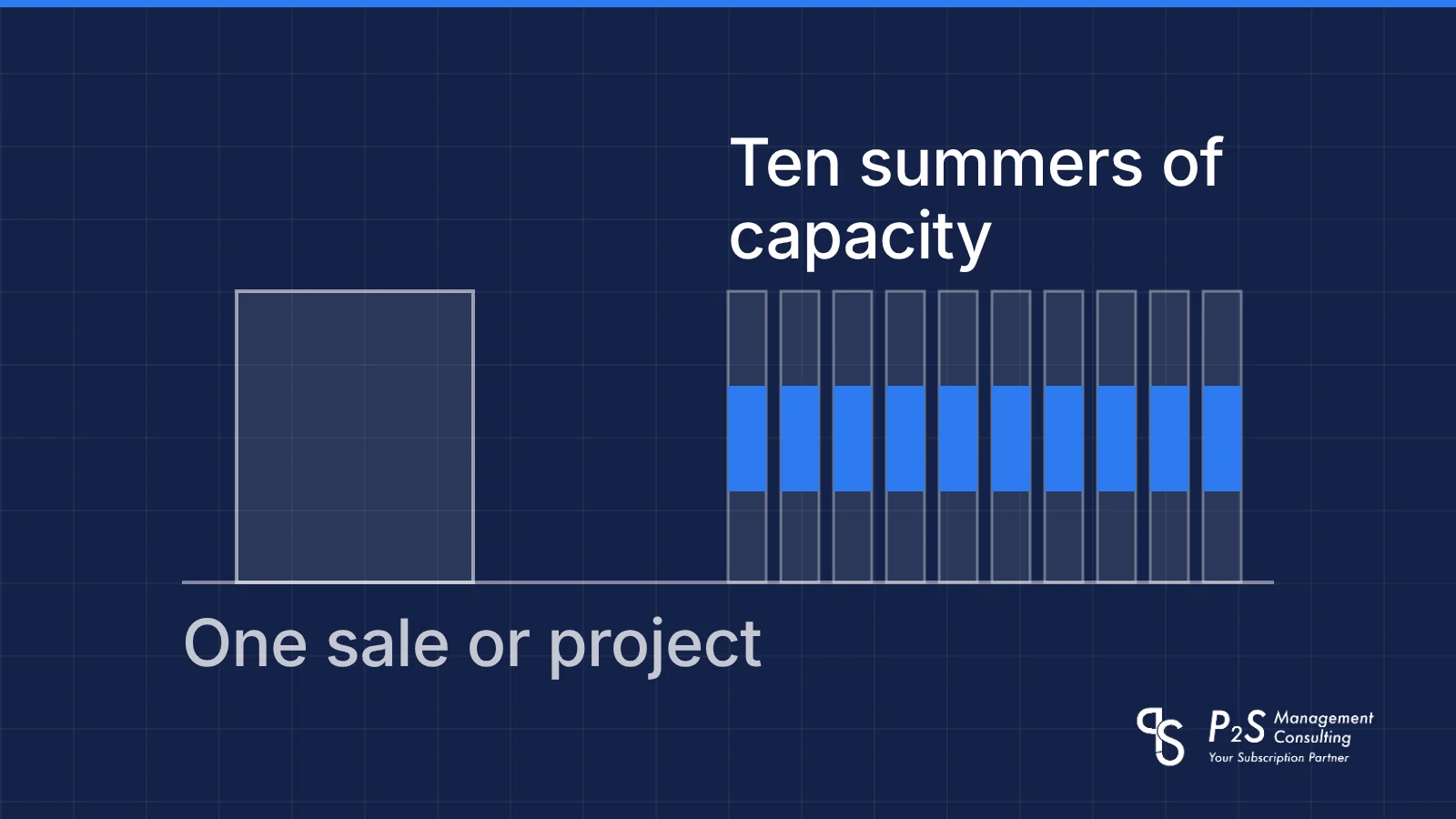
The prize is a contract, not an order. The provider in the case below holds ten summers of reservation payments from a regulated utility, and its battery can also trade in the wholesale market, though 75% of that revenue is credited to the utility.
For a maker, the risk is becoming a line in someone else's bill of materials. In that case the contract went to a developer that builds, owns and operates storage. In our view, the ten-year utility relationship sits with that contract holder, whatever battery stands on the site.
For an integrator, the risk is becoming the subcontractor of whoever bids. Siting, permitting and installation decide delivery dates, so an integrator that knows local codes is worth more as a named partner than as a price line.
Regulation is opening a flexibility market for third parties. In the EU, Article 32 of Directive (EU) 2019/944 requires Member States to allow and incentivise distribution system operators to procure flexibility, storage included, and network plans cover it as an alternative to system expansion. In New York, the Public Service Commission has extended Con Edison's Utility Dispatch Rights programme to 2030, which the utility says lets it contract more third-party storage.
What a non-wires alternative is
Definition. A non-wires alternative (NWA) is a contract in which a network operator procures distributed flexible capacity, often battery storage, instead of building or reinforcing grid infrastructure. Some utilities call it a non-wires solution.
We cover industrial and commercial storage: front-of-meter batteries near the constraint and behind-the-meter batteries at factories and commercial sites. Home batteries, sold to households through aggregators, are out of scope. Behind the meter the answer changes: the host's own use of the battery competes with the operator's call, so the contract has to rank them.
Who pays for the energy. In Con Edison's terms the provider owns, operates and maintains the battery and the incentive does not pay for operation; Agilitas, selected in the case below, charges from the grid off-peak. In our reading, charging energy and running costs sit with the provider. The incentive in the Con Edison requests we read is fixed at bid, and we found no escalation clause, so ten summers of cost movement are the provider's to price in or to negotiate as indexation.
The case: ten summers for a Queens substation
Segment: front-of-meter storage in an industrial zone, New York.
The customer problem. Con Edison forecast that load in its Newtown area of Queens would outgrow the local substation and feeders. In June 2019 it asked for about 10 MW of storage load relief, preferably operational by May 2021.
The commitment. Bidders had to guarantee load relief for at least ten summers in a row. Con Edison holds full dispatch rights from 1 May to 30 September, with at least 21 hours' notice and at least four consecutive hours per event. No single bidder could win the whole need. Agilitas Energy, a developer that builds, owns and operates storage, was selected for 4.95 MW of it and describes a 10-year contract to discharge up to four hours during the summer peak (company-reported).
The design decisions. Four terms shape the provider's economics:
- Payment for readiness. The incentive is bid per kW of peak reduction: half at installation, then 5% of it each summer.
- Delivery tested, then paid. Con Edison may test up to once a year, with one retest, and reads real-time telemetry installed at the provider's cost; a weak test cuts future payments, and a weak pre-operation test cuts contracted capacity.
- Remedies by threshold. An event below half the prescribed output earns no reservation payment, and delivery below 90% of contracted kW triggers capped daily damages per kW.
- Shared revenue and an exit. Wholesale revenue is split 75% to Con Edison, 25% to the provider, and Con Edison can release the project with notice by 1 April, after which the provider works the market to buy down the remaining payments.

The result. The 2020 announcement described a 4.95 MW / 20.6 MWh proposal due online by May 2021. In November 2023 Agilitas reported the built 4.8 MW / 23.7 MWh system complete in Long Island City, grid connection expected in 2024, and cited the city's regulatory hurdles and zoning restrictions (company-reported). The design lesson, in our reading: in a dense city, permitting sets the delivery date, and a tender's operational deadline is where that risk lands.
What the network operator is really buying
A provider sells to a DSO by contracting the availability of distributed storage capacity during defined service windows, with telemetry both parties accept as the contractual source of truth. Our microgrid-as-a-service guide covers dispatch rights, availability windows and settlement rules; a network contract adds a test, remedies and a release clause.
| Term | Con Edison Newtown (New York, 2019) | UK DSO flexibility tenders | Point to agree before bidding |
|---|---|---|---|
| What is bought | Guaranteed load relief for at least ten summers | Availability in seasons and time windows set in each tender | Contracted MW at the end of the term, not at commissioning |
| Dispatch | Full dispatch rights, 1 May to 30 September, at least 21 hours' notice | Contracted windows; some products confirm utilisation the day before | Which other uses the battery may serve inside the window |
| Payment | Incentive per kW: half at installation, 5% each summer | An availability fee per MW per hour and/or a utilisation fee per MWh, by product | Which share of the price pays for readiness and which for energy |
| Proof of delivery | Annual test, real-time telemetry read by the utility | Provider metering, validated by the operator | The data source, the test method and the retest right |
| Shortfall | No payment below 50% on an event, capped damages below 90% | Availability payment reduced for under-delivery | Thresholds, caps and which events count as excused |
| Energy and indexation | Provider runs the battery; fixed incentive, no escalation found | Prices set per tender | Who carries charging cost and inflation over the term |
| Term and exit | Ten summers; utility may release with notice by 1 April | Electricity North West awarded 2 to 12 month contracts in 2024 and 2025 | What is owed if the operator releases you early |
In our view, the margin in a non-wires bid is set by the remedies more than by the headline incentive. At 89% of contracted capacity on a hot afternoon, a battery pays damages; below half, it earns nothing for that event. Bid the capacity your system can prove in year ten, not its nameplate in year one.
In our engagements, the most common failure we see is choosing the wrong model for the buyer, or promising one the provider cannot measure. Network contracts make the second hard, since tests and telemetry settle payment: a sound first contract for a provider already reading its batteries remotely.
The compressed-air parallel, and where it stops
Our whitepaper calls compressed air the closest industrial analogue to storage sold as one of the grid flexibility services. Under Atlas Copco's AIRPlan, Atlas Copco installs, maintains, monitors and updates the equipment, and the customer pays a monthly fee for compressed air instead of buying it (company-reported). The plant buys air instead of compressors, the network operator capacity as a service instead of a substation; in both, measured data underpins the bill.
The parallel stops at the billing unit. A factory pays for air supplied; a network operator pays mainly for capacity held ready. In its 2023 Jamaica Station request, Con Edison commits to at least one test event each summer and to no fixed number of real ones, while UK DSO tenders can add a utilisation fee per MWh delivered. A non-wires contract is a readiness business, to be priced and staffed as one.
Stacking revenue under the operator's call
Revenue stacking works when the network operator's dispatch right takes priority and the contract states how other revenue is shared. In its 2023 Jamaica Station request, Con Edison allows programmes that do not conflict with its first rights of dispatch and asks bidders to disclose other expected revenue. In the wholesale markets FERC oversees (not ERCOT), Order No. 2222 requires operators to admit aggregations of distributed resources, coordinated with the distribution utility, with rollout phased to 2030.
The control test is who decides what the battery does on a given day. Points to agree:
- Who decides charging on days the operator may call.
- Which revenue streams the operator shares in, and at what split.
- Behind the meter, which use wins when the host's peak and the operator's call fall in the same hour.
Our position: a bid that needs the stacked revenue to pay back is a merchant project with a utility logo on it. Let the contracted payments carry the asset, count wholesale revenue as upside, and check what the release clause pays: in Con Edison's terms, market revenue is offset against the remaining payments.
When a smaller role is the better bid
Take a smaller role when:
- No telemetry both sides can read. Supply the contract holder while you build remote monitoring.
- Ten summers of capital are beyond your balance sheet. Let a developer or investor hold the contract, and bid as its named partner for delivery and maintenance.
- The site cannot be permitted in time. Pass on that tender.
- Your capacity in year ten is uncertain. Offer fewer MW, at the level you can prove after degradation.
Frequently asked questions
Should a battery maker bid for non-wires alternatives?
A battery maker should bid for non-wires alternatives when it can read its systems remotely, fund the asset or bring in a partner who will, and give its installers a defined role in delivery. Until then, supply the contract holder and agree with your installers who leads which bids.
What is the difference between a virtual power plant and a non-wires alternative?
A virtual power plant is the aggregation technology, and a non-wires alternative is the procurement contract a network operator signs to defer network investment. A demand response aggregator's fleet or a single front-of-meter battery can answer an NWA tender.
Why would a network operator not simply own the battery?
In the EU, Article 36 of the same Directive requires Member States to bar DSOs from owning, developing, managing or operating storage, with narrow regulator-approved exceptions. In the US some utilities do: in 2017 Arizona Public Service announced its own 2 MW / 8 MWh battery to defer upgrading a 20-mile line. For a maker, utility ownership is an equipment sale; an NWA tender is a contract.
What happens if the network operator no longer needs the capacity?
That depends on the release clause. After a Con Edison release, the utility keeps paying the remaining reservation payments, less 75% of the provider's wholesale revenue, which the provider has to work to maximise; UK DSO contracts are shorter, so the risk shows up at renewal. Agree what is owed on release before you price the term.
Pick your seat before the tender
A network tender rewards whoever can prove capacity, carry ten summers of remedies and finance the asset. Decide which you hold today: the whole package as contract holder, delivery as named partner, or hardware as supplier while you build the rest.
Most makers and integrators we speak to want this market; the first contract needs skills and capital they have not yet assembled. P2S can help as adviser, or step in as operating partner in a co-venture with a maker or an integrator, where part of our fee depends on the recurring revenue the contract brings in.
Book a call with a partner to test which of your installed or planned storage sites could bid into a network operator's next flexibility tender. Book a call. For the availability contract architecture and the CEO checklist, download Beyond the Meter.
Related reading
- Microgrid-as-a-Service: dispatch rights, settlement rules and the zero-CAPEX structure
- Energy Storage as a Service: which outcome can you profitably guarantee?
- Energy-as-a-Service explained: who pays for what, and when the model breaks
- The ESCO model vs energy-as-a-service: why shared savings so often ends in disputes
- Risk allocation and guarantees
- Energy Storage & Utilities at P2S
Sources: Con Edison, 2019 Newtown Non-Wires Solutions Energy Storage System RFP; Con Edison, Jamaica Station RFP, Responses to RFP Clarification Questions (21 April 2023); Energy-Storage.news, Work begins on ESS as non-wires solution to New York substation overload; Agilitas Energy, press release (7 November 2023); IMEG, Borden Avenue BESS project; Con Edison, 2024 Sustainability Report; UK Power Networks, Flexibility; Electricity North West, flexibility tender results, spring 2025 and spring 2024; Electricity North West, Flexibility Services Service Terms v3.2; Directive (EU) 2019/944, Articles 32 and 36; FERC, Order No. 2222 explainer; Atlas Copco, AIRPlan; Utility Dive, APS to deploy 8 MWh of battery storage to defer transmission investment (9 August 2017); P2S Management Consulting, Beyond the Meter (2026).
