Key takeaways
- The ESCO model is a contract in which an energy service company (ESCO) installs efficiency measures and is paid out of the savings they produce, calculated against an agreed baseline, usually under an energy performance contract.
- An ESCO is typically paid from a savings calculation against an agreed baseline, while an energy-as-a-service provider is paid for a contracted outcome such as availability or verified output.
- Shared savings works when the baseline is clean, stable and agreed before signing. Where it is not, pricing what can be metered, such as availability or verified consumption, is usually easier to contract and to bill.
The ESCO model is not in decline. Global ESCO investment grew 10% in 2024 to a record 42 billion USD, according to the International Energy Agency, with more than 75% of it in the United States and China. For building retrofits with a stable load and a measurable "before", it works.
The difficulty starts when equipment providers copy it. In our experience, battery, cooling and grid-flexibility providers building their first service offer often reach for shared savings because it sounds like pure value pricing: the customer pays only from what it saves. In practice, every invoice then depends on a number neither party can read from a meter. If you are designing that offer, the decision is which unit to bill: a share of calculated savings, or an output both parties can meter. This article draws on our whitepaper Beyond the Meter, based on P2S research across more than 500 industrial As-a-Service cases.
What the ESCO model is
Definition. The ESCO model is a commercial arrangement in which an energy service company designs and implements energy efficiency measures at a customer's site, often finances them, and is paid from the energy cost savings they generate, measured against an agreed baseline over a multi-year contract.
An energy performance contract (EPC) is the instrument, and the practice is usually called energy performance contracting. EU law defines it as an arrangement in which the efficiency measures are verified and monitored for the whole term of the contract and paid for in relation to an agreed level of efficiency improvement or another performance criterion, such as financial savings (Directive (EU) 2023/1791, Article 2). Put simply, an energy performance contract is the instrument, and an ESCO is the counterparty that signs it and carries the performance obligation.
The US public-sector version is the energy savings performance contract (ESPC): the ESCO guarantees savings large enough to pay for the project, and measurement and verification is required (US Department of Energy, FEMP).
In each case the provider is paid for a reduction: energy that was not consumed.
The three ways the money can move
The IEA identifies two common energy performance contract models: guaranteed savings and shared savings. Outcome-based service models add a third, in which the customer pays for verified output instead of avoided consumption.
| Guaranteed savings (EPC) | Shared savings (EPC) | Verified consumption (energy-as-a-service) | |
|---|---|---|---|
| Who finances the measures | The customer, from its own funds or a bank loan | Usually the ESCO | The provider or its financing partner |
| What the customer pays for | Contractually agreed fees, backed by the ESCO's savings guarantee | An agreed share of the savings calculated each period | A fixed availability and maintenance fee plus a charge per unit of output it actually received |
| What the payment depends on | A savings calculation against the baseline | A savings calculation against the baseline | A meter reading both parties accept |
| Risk the provider carries | Technical performance | Technical performance and the customer's credit | Technical performance, asset life and residual value |
| Where disputes tend to start | Baseline adjustments and the size of any shortfall | The size of each periodic invoice | The meter, if telemetry is not agreed as the source of truth |
The IEA notes that guaranteed savings are generally used where bank lending is established, and that in shared savings the ESCO carries both the technical risk and the customer's credit risk.
The baseline problem: you cannot bill what you cannot prove
The Efficiency Valuation Organization, which publishes the measurement and verification protocol widely adopted by ESCOs (IPMVP), states the issue in one line: savings cannot be measured directly, because they represent the absence of consumption or demand.
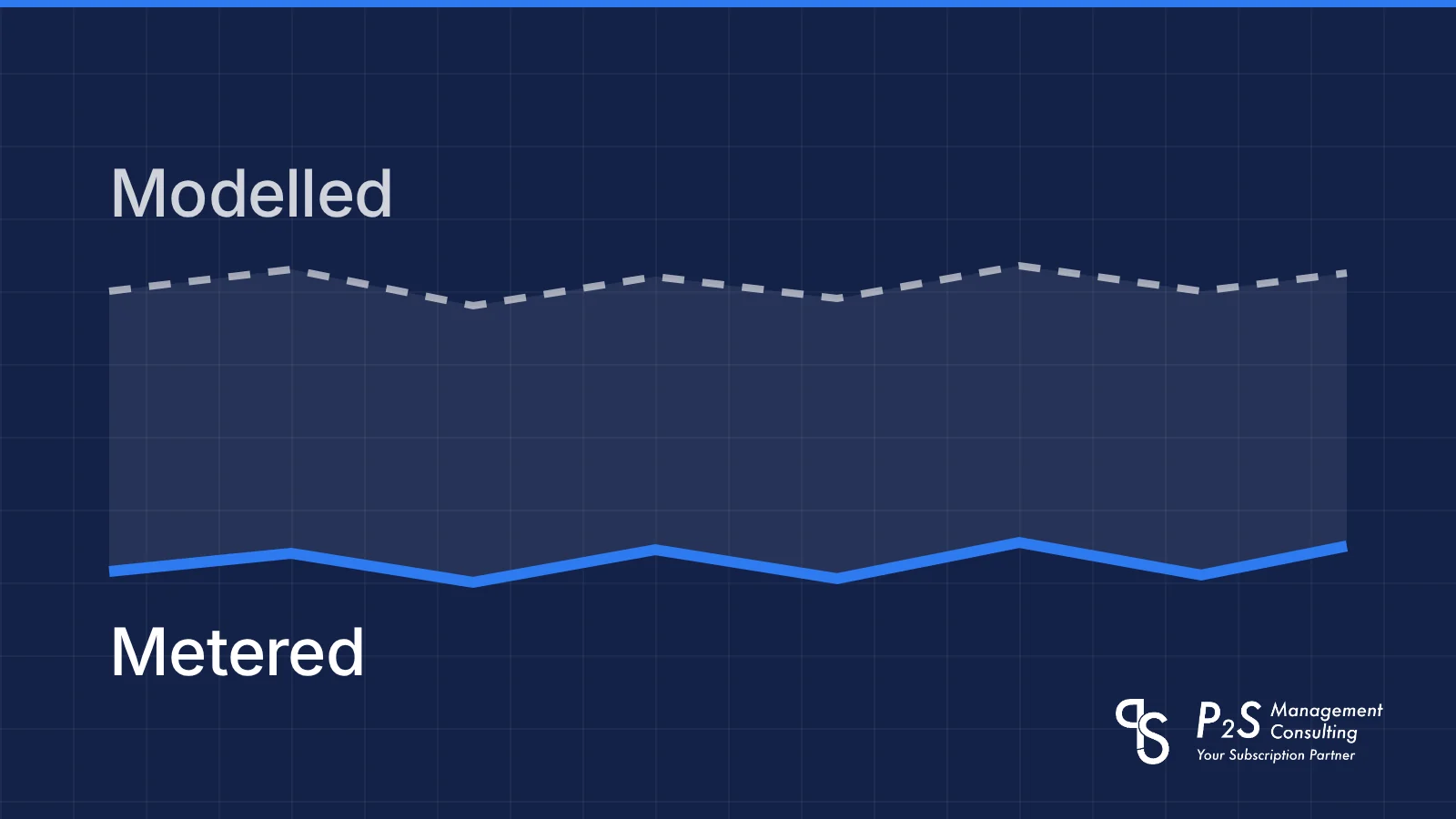
So every savings invoice is a calculation, not a reading. It compares what the meter recorded with a modelled estimate of what the site would have consumed without the project, adjusted for weather, occupancy, production, operating hours and equipment changes. Each adjustment is a judgement, and each judgement moves money between the parties.

EU rules for public-sector energy performance contracts list the same pressure points among the minimum contract items: reference dates for achieved savings, measurement and verification, and a procedure for changing conditions such as energy prices (Directive (EU) 2023/1791, Article 29 and Annex XV).
For a battery, the baseline is even less stable than for a building. A battery that cuts demand charges saves money only relative to a tariff, a load profile and a dispatch schedule, and all three can change during a ten-year contract. Our advice to storage providers is direct: do not promise savings unless a clean baseline definition and a credible verification method are agreed before signing. In P2S research, skipping the verification and governance layers to deploy faster is a recurring cause of billing disputes, margin leakage and renegotiation.
A cross-sector lesson from cooling
A cooling-as-a-service provider in P2S research initially positioned its model around shared savings. Disputes about actual versus projected savings followed, and the provider deliberately abandoned the structure for a consumption-based model in which the customer pays for verified output: the cooling it actually receives.
The transition took years, a proprietary metering system, a dedicated asset management division and several contract rewrites. It is one case in another sector, not proof for storage, but the mechanism transfers. Once the invoice was based on a reading rather than a counterfactual, the monthly argument about the baseline went away, and the provider kept the incentive to run the asset efficiently because it delivered the same output at lower cost. The switch was only possible because it built the measurement layer and the organisation to manage the assets.
When one battery earns money two ways
Storage providers face a problem the building-retrofit ESCO rarely meets. The same battery can earn money by cutting the site's energy bill and by being available to a grid operator or aggregator during defined service windows.
The two logics depend on different things. Capacity access is paid for availability: it depends on dispatch rights, verifiable availability windows and settlement rules. Shared savings is paid for avoided cost: it depends on a verified baseline. Combining them in one offer can work, but only if each payment has its own boundary.
Consider the day of a grid event. The provider dispatches the battery to honour its availability commitment, the site loses the peak shaving it would otherwise have had, and its monthly demand charge goes up. If the contract does not say which commitment takes priority and how the lost saving is treated, both sides have a reasonable claim. Where an offer combines capacity access, consumption charges or savings-linked payments, specify what each charge covers, which operating rights apply, and how performance and payment are calculated. Unclear boundaries create disputes. Our guide to outcome-based contracting and SLAs covers how to write those boundaries.
What to contract instead: pay for verified output
The structure our whitepaper recommends for savings and infrastructure outcomes has three components, each with its own measurement rule: a fixed monthly availability fee for readiness, a fixed monthly maintenance fee for lifecycle care, and a variable charge on verified consumption, settled by a meter both parties accept as the source of truth.

This keeps what customers like about shared savings, no capital outlay and payment linked to use, while removing the counterfactual from the invoice. It also depends on control. AlphaStruxure designed, financed, built and operates a 6.5 MW microgrid, with battery storage as one component, for 70 electric buses at Montgomery County's Brookville depot, at no upfront cost to the county under a long-term Energy-as-a-Service agreement. Stem pairs storage with optimisation software that manages demand charges, with more than 1.5 GWh of storage under management across over 800 sites. In both cases the provider runs the systems that create the outcome. Our energy storage as a service guide sets out how to choose which outcome to guarantee.
What the verification layer costs to build
Before the first invoice a provider needs telemetry both parties accept as the source of truth, automated usage-to-invoice billing, contract governance (KPIs, exclusions, liability caps, repricing triggers) and an asset management capability. Budget for them before choosing the structure. Our pages on value metrics and metering and risk allocation and guarantees cover the detail.
When shared savings still fits
Shared savings is a reasonable choice when four conditions hold at once: the baseline is stable and measurable, the provider controls the levers that create the savings, the customer cannot or will not finance the measures, and both parties agree the measurement and verification plan before signing. A lighting or controls retrofit in a building with steady occupancy can meet all four. A battery serving a site with a changing tariff, a growing load and a grid-service obligation usually meets few of them. If you cannot meet them, narrow the promise: contract availability or verified consumption, and leave savings as a reported benefit rather than the basis of the invoice.
Frequently asked questions
What is the difference between an ESCO and an EPC?
An energy performance contract is the instrument, and an ESCO is the counterparty that signs it and carries the performance obligation. The EPC defines the measures, the guaranteed or shared savings, the baseline and how savings are verified. The ESCO designs and delivers the measures and is paid in relation to the savings achieved.
Is energy-as-a-service just a rebranded ESCO model?
No. An ESCO is typically paid from a savings calculation against an agreed baseline, while an energy-as-a-service provider is paid for a contracted outcome such as availability or verified output. The provider also usually keeps ownership or operational control of the asset and carries lifecycle risks, such as degradation and obsolescence, for the contract term.
Is shared savings a good contract structure for energy services?
Only when the baseline is clean and stable. Shared savings depends on a verified baseline, and providers who cannot prove the savings cannot bill for them, which is why one cooling-as-a-service provider in P2S research abandoned shared savings for a consumption-based contract where the customer pays for verified output. For energy storage, a fixed availability fee plus a charge on verified consumption is often easier to verify and bill.
Price what you can meter
The ESCO model drew a record 42 billion USD of investment in 2024 on a simple promise: you only pay from what you save. Equipment providers moving into services can keep the promise and change the unit. Contract what you can meter, agree the source of truth before the first invoice, and give each payment in the contract its own boundary.
Beyond the Meter: how Energy Storage & Utilities win with outcome-based service models. The whitepaper adds the contract patterns for availability, savings and performance guarantees, the operating decisions behind them, six practitioner cases and the financing options from first project to scale. Download the whitepaper or book a conversation with a partner.
Related reading
- Energy Storage as a Service: which outcome can you profitably guarantee?
- Outcome-based pricing
- Financing and cash-flow structuring
- Beyond the Thermostat: outcome-based service models in HVAC
- Energy Storage & Utilities at P2S
Sources: IEA, Energy Service Companies (ESCOs), ESCO contracts (2018); IEA, Why the growth of energy service companies is uneven globally (2026); Directive (EU) 2023/1791 on energy efficiency, Article 2, Article 29 and Annex XV; US Department of Energy, About Federal Energy Savings Performance Contracts; Efficiency Valuation Organization, IPMVP; AlphaStruxure, Brookville Smart Energy Bus Depot; Stem, About Stem; P2S Management Consulting, Beyond the Meter (2026). Practitioner cases are anonymised except where publicly disclosed.
